Speaker by Various Artists

175

Medical Journal, Chapter V

by Paul Brislen

The Vasectomy. The big V. The Snip. Most blokes I know think of it as the "You must be joking, no way any quack is coming near me with a sharp knife".

The online resources I've seen, as good as they are, tend to be about everything except what it's like to have a vasectomy. A quick Google for "vasectomy FAQ" brought up some fairly dry information ("the likelihood of having an allergic reaction to the anaesthesia") or some medical clinic advert that has a happily married man gazing out from carefully arranged family photos (the wife, two children aged about six and ten, possibly a Labrador) with nary a pained look on his face. He doesn't even have the decency to look sheepish.

I've been married for a million years and we have two gorgeous kids but frankly if we have any more we'll have to buy a people mover, you know, one of those seven-seater bus things with the high sides and the small wheels and you just know it will steer like a cow, and if we do that I may as well just take out my testicles entirely.

So we had The Conversation about various forms of contraceptive and that never gets old, right? And so it was off to the general practitioner's office I go. Went.

My GP is Dion and although he never prescribes drugs when I want them, we can talk about these kinds of things. He laughed at me, which I find oddly reassuring in a health care professional.

There's no way I wanted him telling me to drop my pants, but I wanted him to refer me to someone who would – someone whom I would never ever have to deal with ever again. Ever. For any reason at all. It was my only requirement and Dion understood completely.

Dion referred me to Gerald Young at Auckland's City Med clinic. Sadly, Gerald is exactly the kind of doctor I like – chatty, casual, practical. He has a great line in one-handed jokes (they come in handy later) and I would be happy to go back to see him as a doctor, but sadly we can't do that now that we're intimate, as it were. Sorry Gerald.

Gerald gave me a booklet, set a date and talked me through the process. I'd have to be picked up afterwards as the drugs can make you a bit wobbly, take a couple of days off work, wear two pairs of underpants for the support for a while (no boxers!) and come back in a couple of weeks with a sample. If all was clear, resume normal conjugal activities. If not, wait a while, come back with a second sample and they'd take it from there.

That was fine but then I read the booklet.

The day before surgery I would have to remove all body hair from the surgical site. Gerald translated that for me so I could understood what it meant. Unhappily, I understood what it meant. I would have to shave my scrotum.

Allow me to pause here for a moment while you take a breath or two. To make it easier for you to read on let me just say this was the worst part of the whole thing. The absolute worst bit. Apart from writing about it for a general audience, but that's another problem entirely.

Off to the chemist my (oddly gleeful) wife went to get me some mysterious pottle of depilatory cream. Some fun with a spatula later, I was unimpressed with the results. It's not as if that particular part of the male anatomy is up for any prizes in the beauty stakes at the best of times but the porn star treatment made it worse.

Now for some serious consumer advice. Buy the cream a week or two ahead of V-Day and try it out on a delicate part of your anatomy. You should do this because I didn't and I waddled in on the day with quite a nasty rash. Apparently I should have chosen a more delicate cream and once he'd finished hooting with laughter at my distress (told you he was a good bloke), Gerald wrote out a script for some kind of soothing balm.

Onward to the job in hand. As it were.

I was to go into a little room, take off my trousers and shorts and leave them in a pile, wrap the sheet around my waist and then head into the theatre. A nurse would be organising stuff around the edges but she'd leave before we got down to business. The whole thing should take about 20 minutes at most. Did I need to go to the bathroom for a nervous one, asked Gerald? No, I'd already done that.

Gerald gave me a couple of pills which was very nice of him. I have no idea what they were but by the time I'd taken off my pants I was quite relaxed. Actually, very relaxed. Gerald brought me through to the table and explained that he'd have to "tape this out of the way so it doesn't try to get involved" and we had a jolly good laugh about scalpels and whether a two-for-one deal on circumcision/vasectomy couldn't be arranged. Oh how we chortled. Gerald asked me my views on a particular car and while I was describing its road handling abilities versus its fuel consumption (I know nothing about cars but didn't let that stop me) he interrupted to show me a piece of macaroni. I was unsure why he would do that but he explained that he had me so drugged up that he could "pretend" to do the procedure and send me on my way and I'd be none the wiser and this was proof that he'd done something. Then it dawned on me what he was showing me and frankly if it wasn't for his lovely pills there would have been trouble.

Instead I was simply mildly surprised because I had no idea we'd even begun the procedure. Gerald doesn't use a scalpel at all – he has a one-handed instrument thing that looks like it would be good at a barbecue. There's no pain, no fuss, just some tugging and the odd sensation of having your penis taped to one side. Unless that's a regular thing with you, of course.

Suddenly we were done. Gerald was helping me up off the table, I pulled on my underpants (both pairs) with no real problem. Gerald explained there could be what would look like bruising on my scrotum but that was quite normal and to take it easy for a couple of days. I asked about coming back to take the stitches out and he told me there weren't any – the holes in the underside of my scrotum were too small to stitch!

And now we get to the best bit. I think my wife must have put The Word on the kids because when they arrived to pick me up they were silent and big eyed all the way home. I was put to bed and told to rest but it was about four in the afternoon and while I appreciated the gesture, I got bored so went out to the lounge to watch some TV with the kids. I had the next day off work but when I woke up I felt fine – just a slight twinge in my lower belly. I went out and mowed the lawn. Either way I was ferried cups of tea and generally treated like lord of all I survey for quite some time.

Two weeks later I took my sample in for review. It's not as entertaining as you'd think, whacking off into a plastic cup, and was a tad painful in a "ripping a sticking plaster off in one quick motion" kind of way. Otherwise, job done.

Would I recommend it? If you're done having kids then yes, resoundingly. But here are a few words of advice:

1: Get the gentlest depilatory cream you can.

2: Find a doctor you never have to visit again.

3: Don't let on how easy it is – wives need to know you're going through a major psychological event so they can give you the maximum brownie points for your efforts. I know one guy who got a surfing holiday for his troubles.

4: When someone asks you to write about it for a magazine, don't commit to any deadlines. It's taken me about four years to write this.

101

What PACE actually does

by Robyn Gallagher

There's been a bit of discussion in the press about PACE (Pathways to Arts and Cultural Employment) - Work and Income's programme for unemployment people seeking work in artistic or cultural fields - and the current government's lack of love for it.

When PACE was introduced by Labour in 2001, for the first time people receiving the unemployment benefit who were seeking work in arts or cultural areas, could honestly look for such work and to not be forced into any old job.

But it seems that since National came to power, while PACE hasn't been scrapped, it hasn't been given much support either. The Dominion Post reports that Social Development Minister Paula Bennett now considers it "not a programme or scheme", but rather "tag in the system that indicates the job preferences of a client".

Well, in 2003 I was tagged by the system.

I'd been unemployed for a while and had gone on the dole in 2002. I was initially on the bog-standard dole, and had been required to attend a short course called WorkTrack, designed to teach job-seeking skills to the recently unemployed. It was awful.

All the other people on the course had little education and they were all looking for either labouring or entry-level retail work, and the course seemed geared towards that sort of situation. Two seperate tutors gave the group a little join-the-dots puzzle that was supposed to teach us how to "think outside the box". Ugh.

I came to the end of it feeling really dejected. Rather than expanding my horizons, it had shrunk them. The world of employment had narrowed to that of working at a call centre, with my previous employment in the creative web turning into a pipe dream.

Then early in 2003, a friend told me about the PACE programme. I enquired and was happily switched over to PACE.

Not only that, I enrolled on a year-long course called New Space. It was designed for people who were involved in the arts but currently unemployed. It wasn't so much about CV-writing and tracking down job opportunities (though that was relevantly covered), but more about figuring out what it is about you that was keeping you unemployed. Because, you know, people in the arts, they have issues.

Just as an example - what if you're the kind of person who thinks its unethical to make money from the arts? How do you make a living when you have money issues like that? Yeah, you need to get your shit sorted out.

New Space was hard work, really challenging but totally brilliant. It consisted of day-long classes three days a week for four weeks, then two days a week for six weeks, then monthly catch-ups for the rest of the year. Everyone who did New Space were smart, creative people who wanted to continue working in their chosen field. No one there was trying to scam Work & Income by drizzling some paint on a canvas and saying "Oh, yeah, I'm an artist?"

And New Space really helped me sort through a lot of the bullshit in my life, and I know it also helped the other people on the course. As the course ended, I went straight into employment at TVNZ. I haven't kept in touch with all of the course attendees, but the ones I do know about are working and doing what they love. And that's good.

There's so much work available in the arts and cultural field, but it can be a bit of a rough ride getting established. PACE gives people time and space to get the kind of work they want and are suited to.

For me, PACE never felt like "a tag in the system". It felt more like a smart and active way of helping certain types of unemployed people get work. So it seems strange for the government to not want to support PACE. From what I can tell, it works. People on PACE want to be employed in their area of expertise. They don't want to struggle on a benefit.

4

The Measuring of Heritage

by Hamish Keith

Someone close to the protagonists in the Turua Street debacle asked me if I believed that if people were passionate about their neighbourhood, should that be a sufficient ground for affording those bits they felt particularly passionate about protection. Clearly they did not think so. On the face of it the objection had some merit, but the truth is, at the heart of heritage rows community passion is never too far away. Passion is seldom soothed by political hand wringing, carefully ticked heritage assessment boxes, or promises that the new will be better.

Sadly, the Auckland CBD has whole streets that attest to the lie of the latter and ticking boxes is all very well if the average citizen has any idea of what the boxes mean and why they had been assigned ticks or crosses and just who or what had a hand in the crossing or ticking. As for political hand wringing, that is as much a background noise to the demolition of heritage as is the grinding of bulldozers.

But passion is a subjective thing - hard to measure the value of and, just as likely to come back in a different form to bite the political or bureaucratic bum. Yet passion for continuity is a laudable community emotion. In a very real and tangible sense it is the built past that reinforces that sense of continuity in a neighbourhood. It is one of the social glues that make a place a community rather than just a bunch of buildings with a common name or a common social aspiration. It has a measurable value, but possibly not one to which we can easily assign a set of boxes to tick.

Those pushing for change, development and what they perceive as progress are impatient with and insensitive too that passion for neighbourhood. They dismiss those who voice it, as ignorant busybodies, who should have informed themselves that change is on the way and got over it. For their part the busybodies view the proponents of demolition as greedy and rapacious developers who only care about profit. Sadly there is a bit truth of truth in both views. As a result Heritage rows heat up very quickly and once they do, any common ground is lost.

A major part of the problem is, I think, our definition of Heritage. We tend to do it building by building. Age, aesthetic and association with history or famous people automatically push the heritage button as they should. Only, of course, if there is no underlying commercial pressure, that in the minds of those who would benefit cancel any or all of those indicators out. Tragically Auckland is littered with examples of that. A lean-to in which a famous writer wrote is lovingly cared for, while a 600 seat, purpose-built auditorium a metre or two away from Queen Street, can go for a handful of “urgently” needed carparks.

This in Auckland is a never-ending story. Our desire to conserve the past is seen to be only conditional on that bit of our past having no greater underlying commercial value. This of course is only about buildings. The notion that there is also heritage values worth preserving in contexts is never addressed. The run down and rotting Symonds Street cemetery ought to be a continuing affront to the city, but apart from occasionally arousing the ire of a Herald columnist it goes without notice. Yet there is ample precedent in any civilised city I have ever visited, in making an historic cemetery something of breathtaking urban value.

Here of course, the larger texture of the past is not counted as a Heritage asset.

That, I suppose, is easily rectified with a combination of public outrage and responding political will. It is unlikely there will be much development interest in a cemetery – although in New Zealand we have a habit of running motorways through them – shifting the dead to make the quick quicker. But this gets us no nearer resolving the question of the rights people have invested in maintaining the coherence and continuity of their neighbourhoods.

Obviously there can be no argument for protecting things just because they have always been there. That is as mindless as declaring a street to be a picket fence zone simply because some planner decided that that kind of fence was a heritage kind of fence. (My street, Franklin Road, is a picket fence zone despite the clear evidence that the surviving heritage fences in the street are plastered brick.) But there is an argument for taking the views of the neighbourhood about the neighbourhood into account. Citizens have a right to be heard about how the places they live in will be developed, and even if they are wrong, they have a right and an expectation to be persuaded rather than simply ignored.

Clearly the existing heritage management in Auckland City has no process for doing that. Now the city has been expanded to include neighbourhoods that are fiercely tribal it can no longer ignore an obvious need to do so. There will be no value for anyone in endlessly repeating the fiasco of Turua Street. It is all very well for the developers to argue that there was a rugged heritage assessment and the community was consulted and the community to argue that there wasn’t and they weren’t. They cant both be right.

It will need to be a long and careful process to get the way Auckland measures heritage values right. But it is not something we have to invent. Plenty of cities have been there before us and plenty of them have got it right – or more right than we seem to have. But more immediately something simple and effective can be done. When an heritage consent is being sort – or for that matter any consent that will impact of the character of a neighbourhood – a notice clearly stating that application and the reasons for it should be posted on the site or building involved. What is more it should be posted for a reasonably time and clearly state where in the neighbour models or drawings which show what is intended and its impacts can be viewed.

It is not rocket science and it will not solve all of the problems, but it will at least take the element of surprise and ambush out of the mix. We can achieve that now. To survey heritage management and fix what is broken will take and should take a little longer. But we should start now before the new Auckland is tarred with the old Auckland’s dodgy brush.

18

Pubic Address

by Sally Jones

A while back I found a perfectly formed question mark in the soap that looked for all the world as if it had been written in ink (it hadn’t), with a darling little ‘o’ where a dreary dot normally stands. I was charmed and reluctant to use the soap for some time after that.

But in general, pubic hair appreciation and nostalgia is on the way out. Indeed it could even be said that the pubic age has come and gone.

Still, I can’t help thinking back to that poignant mark in the soap and taking it as a sign that there are indeed outstanding questions to be answered on the whole vexing matter of to prune/groom or not to prune/groom one’s lady garden.

The whole thing is terribly ironic for me. If only I’d listened to my parents who told me to be careful what I wished for. Because in the Ninth Grade I wished for pubic hair; a pubic prayer, if you will.

I began with Santa. At thirteen I was rather too old to write a ‘Dear Santa’ wish list. Would Santa have sufficient telepathic powers to know what I wished for without having it written down in front of him? I knew he could fly and be everywhere at once. I knew he was a trained reindeer handler and that he had command of a sizeable army of elves. I knew he had the power to provide front teeth to selective ‘good’ and toothless children. But what of pubic hair? What was the extent of Santa’s pubic powers? I’m afraid I began to suspect, after another bleak Christmas, not very great at all.

In desperation I turned to God. But s/he turned out to be a bit of stickler for the rules: no faith, no favours.

So what if my expressions of faith were limited to an annual hearty rendition of Hark the Herald – all I wanted was a bit of pubic hair for goodness sake! It wasn’t as if I was asking for the planets to be brought a bit closer to Earth, so that some of the money set aside for space exploration might be diverted to the needy, was it? What were a few short hairs between a girl and her god? Talk about splitting hairs.

When my delayed lady garden eventually grew, it formed a trim island rather patriotically shaped like Tasmania. I was ridiculously proud. Be careful what you wish for? Pah! Parents know nothing. My lady garden was the business.

But before long the island began to develop expansion ambitions, annexing the surrounding territory until it came to resemble the sprawling mainland and I was forced to admit that perhaps my parents had been right.

What to do with these terrible truths?

Having recently been relieved to learn that my vagina is in fact “self-cleansing”, even if it was kind of a case of now you tell me, perhaps this was the answer I’d been looking for? Less time cleaning the garden path could mean more time and energy to concentrate on the garden proper. The logic was solid.

Certainly the revelation has enhanced my life in several, somewhat unrelated, ways. In particular, I can report a surge of identification with my cat, which is helpful as I’m generally more of a dog person and we don’t have one of those (too darned hairy).

Moreover, my self-esteem has taken a boost just knowing that at least part of me is able to take care of itself. My parents needn’t have worried quite so much on that front.

However, while my new found self-sufficiency has freed up time to spend on and in the garden, I’m still finding a lack of motivation to keep on top of the weeding. Indeed it turns out that cleaning the garden path and gateway is one thing while landscaping with hot wax, a sharp blade, and a cracked mirror, is quite another.

But alas, the pressure to prune persists. Does anyone watch The Big C? It’s generally a quality TV show in my opinion. But a few weeks back the female lead, who is dying of cancer, decides to take the plunge for the first time and get a full Montesina wax of her lady garden before she dies. The wax-wielding woman who performs the ritual gives our lead lady a mirror to check her gardening and pronounces the result “sexy.” The woman, gardened to within an inch of her life (if her on-screen screams are anything to go by) exclaims: “I feel powerful!”. Sexy and powerful, what more could a woman, dying or otherwise, possibly want?

Then Harry Potter returned. In the Ladies before watching the latest instalment of the saga, I encountered a further push to de-bush. The advert for the subtly named Off, shows a pot of alarmingly tall and upstanding chives, or possibly wheatgrass, alongside a brazen directive in bold: “Don’t let your Lady Garden go to seed”. Strategically positioned directly above the hand dryer, only the criminally unclean – or self-drying – could avoid it. Harry Potter will never be the same again.

But mostly I blame Gok. His horrendous TV show with all those nervously naked women paraded about for the sake of more advertising revenue kicked the campaign for feminine ‘gardening’ to the next level. At least it did for me.

In spite of my childhood pubic-attachment issues, I eventually decided to take up the blade and mercilessly reduced my hairy mainland to an island once more. Stewart Island perhaps. A hairy pubic Trans-Tasman island surrounded by shark fins, to be more precise. At least that’s the slightly disturbing thought that now mocks me every time I get in the shower and look down.

But there’s no turning back. Nobody ever missed pubic hair. Wished for, but never missed. It’s a case of you’re damned if you do and damned if you don’t, though apparently not all women share this view.

One woman I encountered during the course of a recent medical examination (involving an internal phallus probe) seemed to take great exception to the sight of my fins – adopting a distinct air of disdain that rather strained proceedings and left me with a feeling of: If this isn’t weird and awkward, I’m a turtle.

Of course she might have been objecting to my technique. There are no instruction manuals for lady gardening as far as I’m aware, though Gok is bound to put out a book eventually. The Brazilians have probably produced a treatise or two on the subject, but alas, I don’t read Brazilian.

No doubt my self-styled island is not as sexy as some. Meaner thoughts will surely have crossed the minds of hospital technicians at the end of a long day than “Eww yuk!” Or perhaps the woman was a pubic Nazi moonlighting for Off; perfect recruitment site, a gynaecological ward.

But Off and its technicians, whoever they are, can P-Off, as far as I’m concerned. How much does that painful wax work cost? Is there really nothing more... nothing less... nothing else that can be done?

Fortunately I still believe in Santa. So yes, I do think there is something to be done. This year I’m going to ignore my parents’ advice yet again and make a wish for a self-pruning/grooming lady garden. And just to hedge my bets, I’m going to rejoice and give thanks – in anticipation – with my very own, tailor-made, Christmas carol that begins: “Hark the Herald ladies sing, glory to our new shorn thing” and goes on to suggest that “God and Santa reconcile” just to avoid any charge of supernatural favouritism.

And on that uplifting note I’m Off to prune the hedges.

142

It's called "planning" for a reason

by Richard Goldie of Peddle Thorp architects

My first blog. I’m told you just write as if you were talking -- to be fair the absentee audience is a bit off-putting- heckling from a place of greater safety perhaps? And I’m not that fluid a typist. The good news is that the GFC has afforded us all some headspace, so I’ve used a bit of the time to undertake more of what I call ‘thought projects’. Naturally a number of these are focused on Auckland. I’ll briefly introduce three of them now and hope the feedback will spur deeper thinking and then maybe the chance to speak to these in more depth. Here goes….urban planning!

The harbour bridge issue. “Go tunnel!” I say and let the Waitemata breathe, the real symbol for our new city, united east and west, north and south, around our common harbour. It’s a brand statement about Auckland, New Zealand’s tourism portal. Yes it actually is about environment and it really is great, it is clear. And let’s face it , despite the fancy imagery floating around, by the time we, in our inimitable way,  have ‘optimised’ the cost of a new (derivative) one, it’s not going to be a Calatrava is it?

(Calaltrava’s El Alamillo Bridge, Seville)

Why be derivative when we actually do have authenticity? It’s always hard to see, hiding in plain view as it does. The old bridge- loveable? I think not, unless you prefer irony to authenticity. A new city demands a new attitude; let’s park irony and derivatives and embrace what everyone knows when they see it- authenticity.

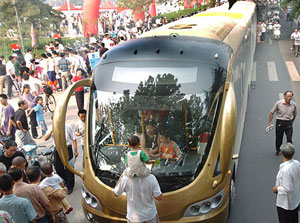
Buses instead of trains. Given that we actually have a ‘low density’ city why are we bothering with trains? I’m impressed with the North Shore busway, a dedicated lane for buses that is doing the job of (and anticipating its future use by) light rail. As is the nature of city development, after some time, these will become light rail routes. Why not introduce busways on to the southern and western motorways too? And why not bigger buses? The Chinese are leading the way - the image here is of a three carriage-long beast- exhibited on - get this - China’s annual no car day!

We already have heaps of bus infrastructure; these are called ‘roads’. On roads, buses can therefore penetrate where trains can’t, doing both jobs. Train station park and ride carparks only hammer home trains’ inflexibility.

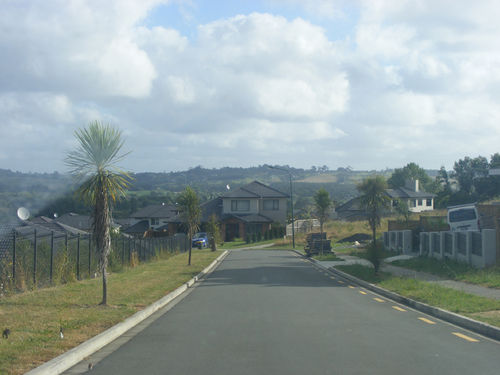
Urban limits. Talk of an ever more expanding Auckland is premised on the reasonable idea that we don’t have enough space for new housing and that affordable housing can only be achieved by delivering more land. The error is to suggest there is a land shortage and we can address this only by releasing more land at the periphery. In truth we have plenty of land. We are hooked on a poor residential housing model- suburbia. The new suburbs at the periphery have houses that only look suburban on lots that don’t deliver ‘sub-urbanity’.

They deliver moderate density, poor amenity, high maintenance, at best neutral identity, poor streets and force affordable housing to the periphery chewing up land and burdening residents and ratepayers with time-poor and fuel inefficient commuting options. The tragedy of the fact that four times as many children are killed on suburban driveways than in swimming pools, only demonstrates to me that our suburban models don’t deliver the outdoor amenity they promised. But I don’t believe high rise is the answer either, I think high rise is a convenience that allows us the political expediency of preserving the suburb, and which delivers nothing of what we love- being outdoors. And as for infill housing, don’t get me started- infill housing is a suburban scourge. Greater density can be achieved by saying, “ok you can build three dwellings in your current site- terrace houses, 2 or 3 storeys, aligned to the street, with a decent private outdoor space out the back”.

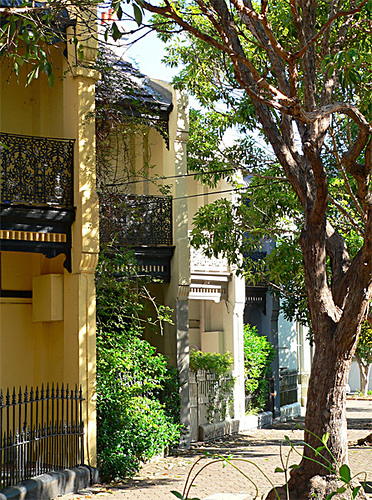
The result is great streets, great amenity, safe streets, walkable neighbourhoods and a density that delivers great high streets and of course, successful public transport.

It’s called urban PLANNING!