Speaker by Various Artists

37

Assiduous, Unrelenting

by Giovanni

Week three, and the last, of my trip to Italy with Joseph. Things are winding down and the boy persists in coping admirably with the high levels of stimulation and the extraordinary levels of cheek-pinching (the dreaded ganascino). The trip was engineered as a chance for him to spend some time with his grandmother and experience his other home country, at an age when he could form a lasting memory of both, so only time will tell whether it was a complete success. For mum we know the time has been precious, so that's a job well done.

And Venice was glorious. Although quite possibly the most tired cliche in Italy is the one that goes "Venice is beautiful, but I wouldn't want to live there", on the evidence of a one-night stay Joseph would strongly beg to differ. We were unstoppable. We saw the sights and we smelt the smells. We crossed the bridges and walked a walked and walked. We jumped on and off boats (except the gondolas. 80 euros? you've got to be kidding me). We had the bizarre, moment-frozen-in-time experience of boarding the Amerigo Vespucci, a magnificent school ship that usually operates out of Livorno but that Joseph knew from its visit to New Zealand a couple of years ago. And we even caught a glimpse of the extraordinary work that goes along and underneath the waterline to keep the city afloat. As a local work in progress sign eloquently put it, 'because of its extremely delicate environmental and urban fabric, Venice requires assiduous, unrelenting care.'

It seems to me that you could say the same of the work that goes into maintaining a family's fabric of memory, that same fabric that we're trying so earnestly to weave Joseph into. It pains me a great deal that he'll never meet my father, talking about him is all I've got. But I have to do it, and in a way that makes sense to a little boy. I know the stakes quite well: for what were probably entirely justified reasons, my father never spoke to me about his own, who died over fifty years ago, and that's a connection that is forever severed. A generation's silence is all it takes.

I touched in my two previous posts on the role of food and objects, and a lot more could be said of rituals and symbols and language, but of course memory travels primarily via people. That's why every family or group, it seems to me, needs at least one dedicated custodian of the past, somebody who keeps track and helps makes sense of those other things, the raw materials of memory, as it were.

On my paternal side, unfortunately, there is no such person. I could name a few of the people in the old photographs and reconstruct that half of the family tree going back a few generations by studying the appropriate documents, helped by the fact that many of those ancestors lived in a big city, but there is no longer a living connection there, no meaningful sense of family holding those documentary traces together.

On my mother's side we're considerably more fortunate. There was my grandfather, the local tailor, of whom they used to say that if the land register had been destroyed in a fire, he would be able to recreate it from memory without breaking a sweat; there was my cousin Mario, last of the storytellers and amateur historian with a passion for the local fables and the monsters evoked to scare the children into not exploring the wells or straying from home at nigh time.

And now we have his sister Maria, his younger brother Bruno and my mother, plus others in less of a full-time capacity. They're not only the people who can tell you who's related to you and how - last week Bruno stopped a passing tractor just so he could introduce me to the driver, who happened to be the grandson of one of my grandmother's sisters - but also, and more importantly, the ones who know how things used to work and who bother to retell the family stories, allowing us to feel that there is a debt of affection that rests on something older than each of us. Which helps I think to explain why, while there are many aspects of the culture that I have struggled to comprehend since moving to New Zealand, the concept of whanau isn't one of them.

Speaking of debts, I promised to update you on my attempt to master the art of pane ferrarese, the miracle bread that keeps on giving by turning over time into breadsticks, so let it be my parting gift. It is fitting, too, that I should return to the food, because it is around the table that those family memories are more easily shared: if you want a captive audience for the fifteenth retelling of a particular yarn, you had better set the table first, and set it well. On to the recipe, then.

First of all, by way of enticement: I met an old Italian gentleman in Hastings who hails from Veneto and in his youth used to travel to Ferrara to swap his wine with bread - that's how good the stuff is. And secondly, a disclaimer: I have been far from successful thus far. Indeed, I have it on good authority that the local water is a key ingredient to this bread, so it is entirely possible that it is a product of the land, just like the famously inimitable Parmigiano Reggiano. But I'm not giving up quite yet, and neither should you.

Ingredients for four loaves, or "ciope"

500 grams high grade flour. Ideally you'd want the double zero type, an extremely fine grind, but it's hard to come by outside of Italy.

50 ml extra virgin olive oil. The recipe actually calls for 50 grams of lard, but it's okay to make the switch for the sake of our vegetarian and vegan friends.

Salt to taste, let's say a teaspoon and a half.

20 grams of fresh yeast.

150 ml of water.

The preparation calls for an inordinate amount of kneading, which is possibly where my first attempt fell short - I simply didn't have the time. So set the breadmaker to its heaviest workload or set aside twenty or so minutes of patient manual work, until the dough is nice and soft and elastic. My mother tells me they used to do this on Sunday nights, leave the dough to rise overnight then shape to the loaves in the morning before taking them to the baker's to cook. But a couple of hours of rest into a dark and dry place ought to suffice. Once the dough has risen, split it into 8 portions of equal size. Each of them needs to be flattened into a long, thin strip, which then needs to be worked starting at the top of the short side using the palm of the hand, in short back-and-forth motions so as to roll it at each end and at the same time flatten it in the middle. There are some really helpful pictures on this here forum, scrolling down to the middle of the page. Except it's far easier to create two halves separately from two separate strips rather than using the same strip, then what you do is pinch the halves in the middle instead of doing the flippy thing shown. Bearing in mind that what you want to achieve post cooking (20-25 minutes on a hot oven at 220 degrees Celsius) is this:
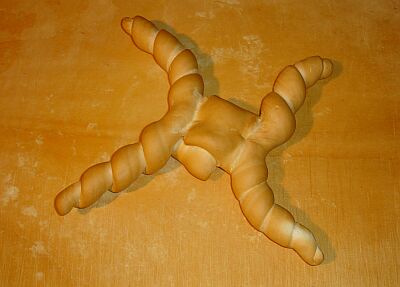
My mother enjoyed giving me the demonstration; the bossing me around part, sure, plus she hadn't tried her hand at it for close to seventy years, so it was a trip back in time in and of itself. As it turns out, it's like riding a bicycle - it all came back to her. I'm quite determined to be that person some day.

Giovanni Tiso
27

Objects to Remember With

by Giovanni

When Justine and I left Italy to come to New Zealand, my parents gave us a little bundle of heirlooms, including one that had nothing to do with the family or its history in a direct sense: a small ancient Roman oil-lamp. Its value isn't monetary, nor aesthetic - it is dirt-encrusted and the handle is broken, the little spout chipped, in parts of the country you could find dozens just like it if you knew where to dig - but to me it has come to symbolise continuity and family and home in a way that few other things could. Nowadays we keep it next to a photo of my father in the closest thing we have to a little shrine.

Now that I'm back as always I am forced to ask myself what it is that makes me miss the old, very old and downright ancient stuff that one finds more or less lying around the place. All the more so since Milan lacks the obvious charm of so many other Italian cities, and a good deal of our old stuff isn't of the variety that makes the tourists flock and the cash register ring. Our most iconic building, the Duomo, is a hodgepodge of styles and took centuries to complete - apparently the good people of the city, fond as they have always been of enterprise and commerce, harboured some reservations about the value of its chief monument. The other star attraction, Leonardo's Last Supper, started to peel off the wall when it was barely finished, and the monks who had commissioned it duly proceeded to cut a door through it, just so they could get from the dining hall to the kitchen more quickly. All for the sake of open plan living, you see.

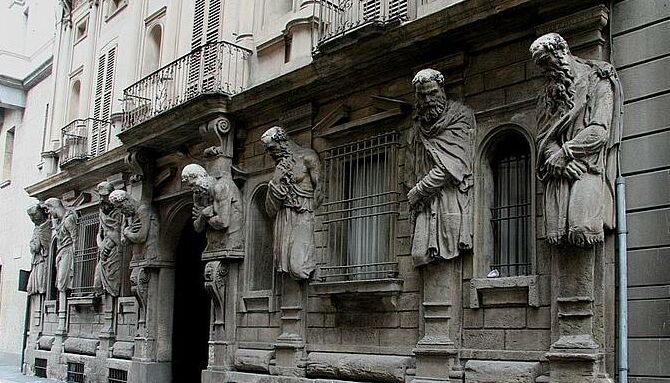
So the city has a less than enthusiastic relationship with its heritage, and perhaps ten years ago I did too. But now I find myself far more attached to the urban landscape than I was, smog-covered warts and all. One could blame the nostalgic sentimentality of a migrant, and I'm sure that it's at least partly the case. But being away also means looking for ways to remain connected, and not just through the magic of Skype, indispensible as that is; one also longs for a sense of place, and for the aura and physical touch of objects that have been around for some time, enough to see the local history unfold around them, as it were. Me, I especially like these eight dudes:

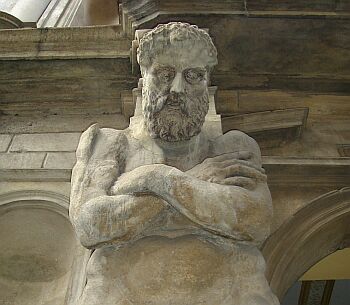
The {Omenoni}, or big men, have been around since 1565, tucked away in a little street behind Piazza della Scala, quietly observing the human traffic, their porous stone getting impregnated with the sooty dust that we've all been breathing. Like so many of my favourite corners of Milan, they are quirkier than they are charming or beautiful in the traditional sense. They are also solid and hard-working, so they fit in well with the local ethos. And one cannot help feeling sorry for them. Joseph wanted to take a picture of the one that seemed the saddest:

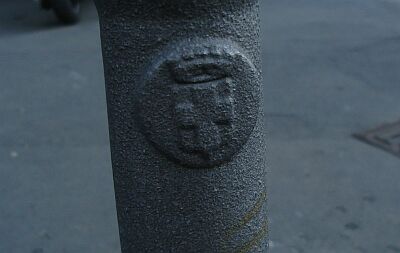
Not surprisingly, the young fella is fascinated by the surroundings, and has been full of questions that I've been somewhat over-zealously attempting to answer - having the whole "the Romanesque comes before the Gothic period" conversation with a seven year old ought probably to be regarded as a form of abuse. So oftentimes he lets me drone on while he busies himself taking pictures. I don't think he necessarily does it in order to look at them again in the future - it is simply part of his way of looking. And, like most children his age, he likes to focus on the unlikely details, such as cobblestones or the embossed coat of arms of the city on a cast iron post.

Naturally his pictures, far more than mine, are the ones that capture that ineffable essence of place that makes my memory tingle; shots that I wouldn't have bothered to frame because their individual parts are unremarkable if not downright ugly, but that taken together make up postcards of the Milan that I know - a city that hasn't aged as gloriously as some others, and is more well-worn than it is pretty. Not unlike our humble oil-lamp, encrusted with a past that is not ours, but that speaks to us, and becomes an object to remember with, to think of the people and the ways of being and doing that came before.

Mum's house is full of such objects, thanks in part to the heroic frugality of past generations: I'm thinking especially of the square knife that my grandmother used to cut tagliatelle with, made from the recycled blade of an old scythe, and at least two packs of cards that my parents shuffled into oblivion playing patience in the evening, and that my mother uses to this day, insisting that she has no trouble at all counting the seven diamonds on the settebello through her cataracts. And good on her, perhaps some day I'll do the same.

Giovanni Tiso

22

Memory Food

by Giovanni

I'm off to Italy with my oldest son, Joseph, who turned seven last week. He has been there before but this is the trip that I have some expectation he'll remember, so we'll try to do the odd extra-special memorable thing - two days in Venice ought to cover that - and get him acquainted and re-acquainted with the people and the places that my family and I cherish the most. My mother's age and ill health lend some urgency to these endeavours, and we take that seriously, but of course we are also mindful that the young lad needs a plan of fun.

As luck would have it, much of my family's memory travels by means of food, and Joseph is not going to mind that one bit. I promise you it has got nothing to do with Marcel Proust and everything to do with the surname on my maternal grandmother's side: Magnoni, or 'big eaters'. My grandma (hereinafter {nonna}) married a Farina (or 'flour' equivalent to the Anglo-Saxon name Miller), and that took care of the need for ingredients.

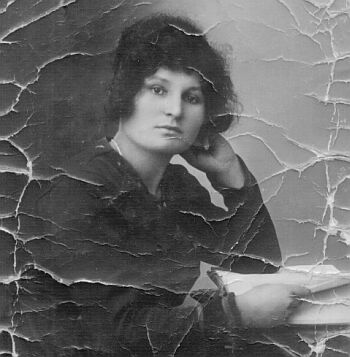
Here she is, my nonna, aged 16.

It was her first ever photo and there wouldn't be another for close to fifty years. Of her own mother, who died in 1911 aged 39, no picture was ever taken, which of course was not at all unusual in those days. But it does put the notion of how you remember your ancestors in perspective. Nonna was barely literate, worked as a seamstress of her life, and left none of those documentary traces that nowadays we demand of ourselves and society and decorum demand of us - my partner and I have taken roughly one squillion photos of Joseph alone, for instance. But she was a good person, a socialist back when it meant something, generous, a great cook, loved her whanau fiercely.

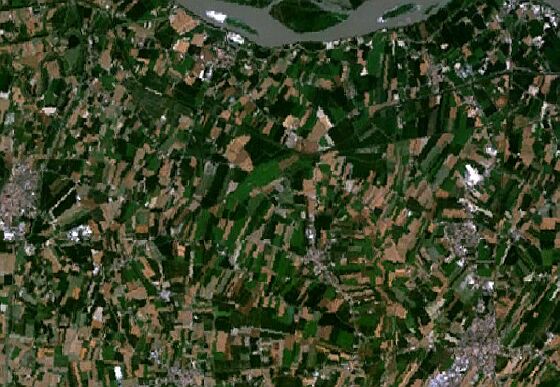
And boy, did she not travel. Close to her entire life was spent on this rectangle of land, measuring scarcely 15 miles across. Born in Pieve di Coriano, a long time resident of Villa Poma, died in Quistello. This was her patch.

Armed with Google Earth and some family knowledge, or better still direct contact with the relevant old lady, you too can measure your Grandmother Range, and compare it to your own. The results may or may not surprise you. In the case of nonna, apart from the odd visit to her daughter's family in Milan (that's us) and a trip to Padua to thank Saint Anthony for helping her with a fibroma, the above little patch of the Po Valley, at the crossroads of Lombardy, Veneto and Emilia, the cradle of Parmigiano Reggiano, was her whole world.

I don't know how to explain that to Joseph, who at seven has already touched down on four continents and is reserving the option of one day becoming an astronaut. But I can tell him about the food, and even cook him one or two things, in a clumsy but well-meaning attempt to keep that memory and those connections alive. So, pausing only to acknowledge the formidable Islander, with whom I had a lovely email conversation on the topic of food and grandmothers just last week, here is one of nonna's favourite recipes, and mine. It's for mericonda, breadcrumbs and Parmigiano dumplings in a beef and chicken stock. Or, as my recently converted friend Giacomo calls it, 'boiled dough'. (Cheeky bugger.)

For the stock: half a chicken, 400g of chuck steak - or the piece that in Italian is referred to as the priest's hat, some butchers will know where to cut that - one clove of garlic, one onion, a celery stick, a carrot. Dump everything in when the water is still cold, bring to the boil then let simmer for three to four hours.

For the dumplings: two cups of breadcrumbs, one cup of grated Parmigiano Reggiano (don't even think of buying the fraudulent 'parmesan', you'd make an entirely different dish I'm afraid; Grana Padano will do in a pinch), three eggs. When the stock is ready, simply mix the dumplings ingredients together into a nice moist big lump. If it seems too dry and hard, mix in a tablespoon or two of the stock.

Back to the stock pot: salt to taste, remove the meat, chuck the veges in the nearest compost bin, bring back to the boil and use a two handed potato masher or ricer with big round holes to press the lump into little worms about 3-4 cms long, dumping them directly into the pot. The ricers made in New Zealand are a bit too flimsy for the job, I find, so it may be safer to use a masher. It's essential that the holes are big, though, at least 2.5 mm but preferably 3 or 4. The dumplings cook in a couple of minutes.

After the mericonda you serve the boiled meat ("il bollito"), with some sort of sauce or gravy and potatoes sliced and cooked in oil, with garlic and parsley. The wine that goes with this meal is a red Lambrusco, but I understand that most people abroad - not to mention in Italy - turn down their noses at the idea of a sparkling red. And a novelty wine it may be, but it is a key part of the experience so I'm going to gently but firmly demand that you use it. It is {my} memory, after all, although I would love nothing more than hearing about and trying out the family or ancestral recipes that others might have to offer.

If the concept of boiled dough fails to appeal, I have a couple of testimonials. Here's Joseph:

and here's young Lucia.

The Magnoni genes are strong in this one.

To me a trip home is also a chance to tap into the source of these memory foods, and every time I go I try to learn to make one or two of the old dishes. This time mum has promised to teach me how to bake {pane ferrarese}, a type of bread that defies the laws of physics by keeping for weeks in a steady state of deliciousness -- I'll report back on that. But for now, the lad and I had better be off.

Giovanni Tiso

This guest blog is cross-posted from Bat-Bean-Beam, the weblog of Giovanni Tiso.

18

The Olympic Learning Curve

by Emma August

The Olympics are racing by faster, higher and stronger than ever before (as per) and it’s been one muscle-bound learning curve for me, right from the interminable athletes’ parade at the opening ceremony. Yes, another bloody Games blog. Just a quick one though and besides, the more Olympicked–out you become the more you’ll appreciate the approaching return to normality.

Twelve things I’ve learnt from the 29th Olympiad…

San Marino is a country. There it is, hiding inside Italy. There are four San Marinese entered in the 2008 Games. That’s roughly 0.013% percent of the country’s population, compared to 0.005% for NZ and 0.0002% for host country China. If 0.013% of China’s citizens competed that would make for team of 442,000. Just a thought.

The vast majority of sports photographers and journalists are male. This may explain why I have only recently discovered that men play beach volleyball too, it’s just that the bikini-clad women’s games are more somehow more interesting.

Judoka is a word. Female judokas wear vests under their pyjama tops, male judokas do not. However, this does not balance the bikinis vs. tank tops and baggy shorts disparity in beach volleyball.

Chinese people have little interest in cycle racing despite bike riding being the only form of exercise millions of them do. Why are there no champion Chinese cyclists?

Chinese people have a great deal of interest in table tennis both as a hobby and as a spectator sport. Why are there so many Chinese champion ping pongers?

‘Sold out’ does not actually mean there are no empty seats in the stands.

A gymnast’s identity card proves nothing, as any underage drinker and not so young celeb knows.

Men compete in all Olympic events except the girly ones - rhythmic gymnastics and synchronized swimming. Women compete in all Olympic events including the manly ones – wrestling, boxing and weightlifting. Is it time for men’s lib?

The average Olympic athlete is more attractive than the average Olympic spectator (no snide comments about lady weightlifters please). Appearance matters a lot in middle class China but I was still startled to hear my female colleague say she hoped Shawn Johnson would win the gymnastics floor exercise because “she’s so pretty” to a chorus of agreement. “What about the Chinese girls?” I asked. “Yes, I know but Shawn’s so pretty.” Someone needs re-educating.

Yngling is also a word. It’s a sailing boat class and means ‘youngster’ in Norwegian. Yngling doubles my Norwegian vocabulary from fjord.
It takes a lifetime of hard slog to become an Olympian but no time at all to become an armchair expert on any sport. Except perhaps for judo, which I still don’t get at all.

Yes means no. Yes, you can demonstrate in designated “protest parks” says China. Go for it! Wave those free Tibet banners, chant pro-democracy slogans, cheer on the Uyghur separatists and rant against social injustice all you like. The announcement that special sites would be set aside for demonstrations was trumpeted by state media in July with headlines like, Beijing protest parks wait for Games' demonstrations. (I like the use of “heretic sects” towards the bottom. No prizes for translating that into Falun Gong.) With just a couple of days left until the closing ceremony, the wait continues.

80

It’s Beijing, but not as Beijingers know it

by Emma August

A mere few hours till O-Day and from my living room window the odds that Beijing will be granted a coveted blue-sky day for the Olympic opening ceremony look far longer than the current range of visibility. Hand-wringing city officials will have to activate the top secret emergency plan: Pop up the city-sized blue tarpaulin.

They’ve had a couple of practice runs lately along with rehearsals for the opening ceremony fireworks display and it seems to have gone well. Everyone, including those pesky foreign reporters, was fooled by the azure skies and the accompanying temperature increase. Forget accusations of playing God with cloud-seeding tricks. Just hire all the many migrant workers who have been turfed out of Beijing to erect a fake blue sky. Easy.

Kite flyers and homing pigeon fanciers are the latest old school Beijingers to get the big “NO” from authorities, this time in the name of airspace security.

Perhaps the ban on aerial activities is a ploy to keep visitors’ eyes away from the sludgy skies. Down at street level, 40 million potted flowers arranged in fanciful formations across the city are eye-catching enough to distract even the most heat-exhausted visitor. The leafy mini-Great Wall near the Lama Temple and the herbaceous cyclists racing along Fuxingmen Street are understandable. But the huge flowery ship’s wheel on Changan Avenue, the main east-west thoroughfare, and the Dutch-style floral windmill near my apartment are hard to fathom. 40 million pot plants is a lot to work with. I guess they got desperate for ideas.

Many other Beijing residents are feeling a little desperate lately too. “Tai mafan le!” exclaimed the cab driver on the way to my friend’s house near the National Stadium, gesticulating out the window towards the Olympic Green. Too much trouble. I know what he means and I haven’t been forced to dress like a boy scout in a new uniform. First, cabbies were banned from smoking and sleeping in their cars, now they have to wear ties. What next? White Mickey Mouse gloves like they wear in Japan?

Heaven forbid Beijing becomes the next Tokyo. I spent a couple of years in Japan and it’s hard not to notice the unspoken rules and social constraints when I go back, especially after living in freewheeling China. Right from the airport arrivals hall where an annoyingly officious staff member points to the English word ‘name’ on the form and instructs me to write my name, I always have the feeling I am being monitored to make sure I do the right thing and strictly obey the rules.

In Beijing regulations are usually more like suggestions than orders. Or at least, they used to be. Lately it seems like there’s a new regulation issued every day and these ones are being enforced. Some are about security – vehicle checkpoints set up all round the city’s entry points, random ID checks on the street and bag inspections at subway stations; others are about clean air – half the cars ordered off the roads, polluting factories shut and construction suspended; while others are about image – don’t ask foreigners anything personal and for heaven’s sake don’t go to the store in your pyjamas this month.

The concept behind the Beijing Games is “The Green Olympics, the People's Olympics and the Hi-tech Olympics.” Covering the capital with thirsty floral extravaganzas while surrounding provinces gasp for water does make for a green host city. Maybe the people do prefer it when they can no longer make a living from selling fruit, goldfish, flowers, books and iced drinks off their tricycles along the streets. And perhaps Beijing does look more high-tech with all the huge screens on buildings that are popping up everywhere. But personally I liked it better when there weren’t armband wearing Olympic volunteers positioned every few metres along the streets keeping an eye out for anything unusual and I was allowed to sit on sidewalk tables at my favourite restaurants.

Still, it could be worse. Spare a thought for the families of over a thousand shop owners in Olympic co-host city Shanghai who have just had their businesses closed down for a month. The China Daily reports they will not receive any compensation but most business owners “understand.” I doubt that’s what they said when they went home after getting the order to shut up shop.

Many of the things that are most endearing about China’s scruffy, characterful capital city have been tidied out of sight to ensure a ‘perfect’ Olympics. Although I can (in some cases) understand why, it seems a shame that the country is not yet confident enough to relax and be itself in front of strangers.