Speaker by Various Artists

44

ReEntry

by Daniel K 1

One of the books I remember reading at school, in Wellington in the 1990s, was James Joyce's A Portrait of the Artist as a Young Man. It's a semi-autobiographical account of a young Irish writer, Stephen Dedalus, struggling to create his own identity in the midst of a repressive Catholic upbringing. It is a visceral, powerful book. I particularly recall the lurid hellfire and brimstone school sermons Stephen is forced to listen to, which make Milton seem light-hearted.

Stephen does, in the end, intellectually repudiate Catholicism and consciously adopts the life of a bohemian artist in Paris. But the point of the novel, if it is not too radical to suggest it has one, is that he is never able - no matter what he says or thinks - to shake off his formative past. In moving on, Stephen has only Irish Catholic imagery with which to express his new-found freedom: in trying to escape his background, he merely draws attention to his on-going struggle. The result that, despite his determination, he is now torn; stuck in no-man's land.

Although a rather dramatic analogy, this is is not totally dissimilar to the experience of being a New Zealander. Like Irish Catholicism, our culture is proud, insular and definitive. It engenders both a fierce loyalty and, conversely, a desire to transcend our remote distance and limited perspective. To put it crudely, you can be a Kiwi at home - and risk feeling removed from the world; or you can be one in the world - and assuredly feel removed from home. This is, of course, the dilemma of any diaspora and, for New Zealanders living overseas, a statement of the bleeding obvious. Still, New Zealanders are unusual migrants. Most diasporas are caused by severe economic, social or political events. The Israelites didn't leave Egypt to see the world, nor did the Irish who left for America in the 1840s. The same is true for more recent waves of economic migrants in search of a better life. In contrast, (most of) the one-fifth of New Zealand's population which lives overseas does so by choice.

The unique consequence is that, just as we freely choose to leave, we must actively choose to come home. A recurrent issue in in the brain drain debate is how the government might entice Kiwis to make this choice. One answer I heard to this question was given by Helen Clark, speaking last year at the London School of Economics. After a stump speech she was asked a pointed question from an audience member who said that he had it so good financially in the UK there was no incentive for him to return to NZ. He asked Clark what she proposed to do about this. Her response was equally pointed. He would have to make his own choice, but in her experience many New Zealanders tend to return because that is their country and where they want to raise their families. In other words, Clark recognised the Dedalus factor - the ceaseless pull that our New Zealand identity exerts - and the simple truth that this is more influential than anything government policy, say tinkering with tax rates, could hope to achieve.

From my own experience, there are three ways Kiwis overseas address the issue of home. They: (a) try to banish it, and make a decision to stay overseas; (b) try to exorcise it, and return home; or (c) prevaricate. I presently live in London and have done an almighty amount of (c), as do most of us, especially during wintertime. This, I can attest, does not usually make for scintillating and innovative conversation. But my ultimate choice is (b). In less than a week I will be homeward bound, after almost seven years' away. It is good to have made the decision and to know there will be no more dinner parties with fellow Kiwis drifting, inevitably, to whether and when such a return might be made by any of those present (I will now have to work on my friends from afar!). I am, I hasten to say, not returning alone, but with my wife, who is also a New Zealander. We are very much looking forward to it - though, like many before us, we are not quite sure what to expect. I expect the best approach is not to expect too much: we will simply have to find out.

The reason I am writing this blog - with many thanks to Russell - is to try to describe the experience of coming back: what is good, what is bad and what is simply interesting or surprising. It seemed to me, in the depths of my prevarication, that there was not much ready guidance or advice as to why one might choose to return and what the experience would be like if one did. I know this because I spent far too much time consulting the internet as if it were a divine oracle. One piece of advice I can give for free is that it is probably time to return home when you have googled "New Zealand, long-term happiness, answers" and read hopefully through the results.

I found that the clichés about when and why to go back did not greatly assist. For instance, I was confounded by the idea that you will simply know when "it is time". When exactly is that? And how will you know? The reason it seems so tricky is that, for most of us, the decision to stay or go is not really about timing; it is about identity and values, about deciding what you really want from your life. You will find different things in different places and you can't have it all. The problem is - as Stephen Dedalus found - that we don't tend to decide our values self-consciously; they are influenced by our context and revealed over time by our choices and actions. In many ways, you slowly become what you are (or as an existentialist might say, you are what you slowly become). The key reason my wife and I are returning home is, I suppose, that we were becoming rooted in the UK and didn't want to have emigrated by accident. Don't get me wrong, London has grown on me, as did New York (rather more rapidly) before it. But while is a one thing to live and work in another country, it is quite another to find yourself tied to it, with a house, a job and a life which have become your own through no real exercise of choice. So we are taking the plunge.

I am sure that, whatever we find back home, we have made the right decision and I will let you know how it goes. I hope this post is of passing interest to New Zealanders who are considering going back but are keen to know more about the process of returning. I also hope that it is of some interest to New Zealanders back home who are curious as to the notion of feeling mild culture-shock in your own country. Mostly though, I just hope our luggage doesn't get lost on the way back....

3

Camp as a row of Spiegeltents

by Williams 1

Good god I'm drab. My clothes, carefully picked for the occasion, lack sequins and sparkle, my jeans are too loose and I've not got high-heels. My hair is not nearly sharp enough and my glasses - Gucci but brown - are seasons old. In short, I'm a middle-aged straight man. None of this would matter were it not for the fact that I'm surrounded by Drag Queens and Sydney's finest, most fabulous and famous. Even former Wallaby captain George Gregan's here - though clearly straight, his exotic appearance counts in his favour. I hide behind my wife. Not only is she beautiful, she knows lots of people.

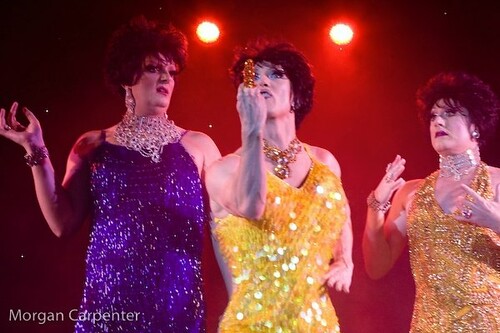
Camp as a row of Spiegeltents, a one-off show produced by DIVA award winning Amelia Airhead, is a celebration of drag in Sydney. Kylie's here, Shirley Bassey too, a few of her in fact. I see an ageless Dusty Springfield and an aged Elizabeth Taylor. Backless dresses confuse me, so too prominent décolletage but more of that later. Tonight, the division of genders is both irrelevant and fascinating.

My first dragshow was in 2002. Late in the evening, my sister-in-laws suggest going to the Imperial. I tag along without realising what the venue is famous for. As we arrive, I assume it's just another of Sydney's gay clubs but as we take seats, it's clear it is not. For a moment, I'm a little nervous. We're close enough to be at risk of audience participation - a risk I avoid regardless of the nature of the performance. However, I'm somewhat relaxed by the incredibly mixed audience. Hens-parties, grandparents and hetro-couples make up a surprising percentage of the audience. Mitzi Macintosh is the hostess. She is Lucille Ball, she is Carmen Miranda, she is Nana Mouskouri. I am transfixed - the show is slapstick and Cabaret. When the buff boys join the glamourious Queens, the sexual tension is elevated far beyond anything the Pussycat Dolls could ever manage. For the next few years every time we host friend from New Zealand, I insist we go to the Imperial. Without exception, both my guests and I have a memorable night.

But back to the Spiegeltent. The venue couldn't be better suited. Built in 1920, the intimacy, the opulence and the mirrors - our host, (Mitzi again!) translates Spiegeltent to be German for Tent of Mirrors - all intensify the boysterous mood. And now the music starts, an introductory medley of disco anthems, Abba and Kylie - my youngest daughter would adore this gig were she not 15 years too young to attend.

The ensuing performance highlights the best of drag starting with the '70s Les Girls through to the latest winners of DIVA awards. The Spiegeltent is raucous; filled with cat-calls and screeches, hysterical laughter and applause. The Girly Basseys perform Goldfinger and I (who have nothing), a small Salvation Army choir perform Saved, Kylie sings Especially for You in duet with Jason Donovan. And then there are those boys again; independently-engineered pectorals, tight shorts confirming the latest trend for male-electrolysis and glittered bodies.

A number of classics from venues now since closed have been revived for the evening, including a classical burlesque striptease that resolves my earlier confusion; as this Queen removes her clothing it's clear she's neither tucked (the technical term for hiding the bloke's bit) nor padded her bra, hers is a permanent reign.

In the break, Mitzy recalls the early development of drag culture in Sydney - a risky venture in less tolerant days where hosts ensured there was always a balance of (gay) men and (lesbian) women should the Police pay a visit. Things have come a long way and there's now a number of drag venues in Sydney city (a full list of current shows is here). Several have recently closed however and the Imperial is still being refurbished. Oxford St remains the centre of the scene with shows Monday through Sunday at Midnight Shift, Stonewall and Arq.

The finale is another performance from Amelia Airhead which brings the boys back on stage. The audience is euphoric as Amelia performs "I Got the Music In Me" resplendent in yellow feathers - I doubt the Peacocks are courting hens tonight. I wonder how long it will take to remove costumes and make-up? I wonder how different the performers feel in street-wear? Not as drab as me I suspect.

It's hard to pick a highlight, impossible in fact, instead check out some of the shows yourself - the Girly Basseys, the Salvos and Mitzy doing 100 - 1.

Paul Williams

122

Database Nation

by Chapman 1

As of Monday 24th November 2008 New Zealanders residing in the United Kingdom on student or marriage visas will be required to hold biometric ID cards, issued by the UK government, containing 49 pieces of their personal information. The following is a backgrounder on how the UK has become a surveillance state and the extreme measures already in place.

London – circa 1984?

There’s an often repeated expression in the English media that claims the UK has ‘slept-walked into a surveillance society’. As though, having turned in one night with a cup of Bovril and Match of the Day playing on the TV, they’ve awoken to a world of CCTV cameras, fingerprinting and identity checks. In fact, nothing could be further from the truth. England is by long measures the world’s most watched country, but to suggest the current situation (which sees children fingerprinted when they take out school library books) is a surprise, is absurd. Great Britain has sprinted into a science-fiction dystopia with all the planning and tenacity of its over-achieving Olympic team.

As early as 1995, the British Home Office decided snooping should become a priority, dedicating 78% of all crime prevention funding to the installation of surveillance cameras in public places. By 2002, a working paper estimated that between government and private projects, approximately 4.2 million of them had been installed in Britain (that’s one for every 14 citizens), with enough in London for an average denzien to make 300 CCTV appearances, across 30 networks per day. Remarkably, in a land obsessed with data collection, the exact number of surveillance cameras is unknown as no official records are kept - it appears that while many may be doing the watching, no data is recorded as to who they might be.

The consequences for privacy are far reaching. Let’s consider a hypothetical situation: a boss takes his secretary to lunch, nothing untoward occurs, but council cameras capture the pair of them dining together, footage is passed on to a third party company who then offer it for sale to his wfie under the auspices of ‘your husband is seeing a mystery woman’. It’s a scenario that reeks of Orwellian paranoia and one that requires behind the scenes coertion between a number of official bodies – but if it seems implausible, take note of Emma Faulkner who, feeling too tired to drive, pulled off the motorway to sleep, only to receive a parking ticket a few days later. Her number plate had been picked up on camera, her car details purchased by a private company from the Driver and Vehicle Licensing Association (the government's national body - which incidentally has sold 5.3 million driver records since 2002), and then issued her with a fine.

If you thought that was petty though, you haven’t heard the half of it. Through a rather liberal interpretation of anti-terrorism laws, over 50% of British councils now spy on householders who put their rubbish out on the wrong day, using cameras in discarded baked bean tins and recruiting unpaid ‘environment volunteers' (PDF link). You’d hate to be new to the neighbourhood, wouldn’t you? But the hardline on keeping Britain green doesn’t end there, with some councils inserting RFID (radio transmitter) chips in wheelie bins to monitor the contents being thrown away (pic here). It’s reminiscent of the East German Stasi.

While it’s easy to evoke Orwell’s masterpiece as a parallel (particularly in light of the irony that four cameras now directly watch his former London apartment), this only paints half the picture. Where Winston Smith was battling the forces of a bureaucracy based on conventional ‘50s technology, Orwell did not predict the rise of computers or the wholesale digitalisation of administration. There are as many likenesses to Philip K. Dick’s nightmarish Minority Report as there are to Big Brother’s all seeing eye in 1984. Surveillance cameras may be part and parcel of everyday life, but it’s the collection and retention of personal data that truly threatens civil liberties. And it’s nigh on impossible to avoid – as I found out recently.

I’m a big fan of cycling. In London it’s my primary form of travel and one I’ve used regularly enough to become a little cocky – a fact I found to my detriment when I dropped my cell phone whilst trying to ride and talk recently. Thinking (as I would in NZ) that it was no big deal to find a replacement, I headed to Oxford Street in search of the cheapest phone I could find. Spotting a Samsung for £10* (I failed to see the asterisk), I took it to the counter. So far, so good.

The catch however, was that in order to buy the phone, I had to also buy a new sim-card with pre-paid credit (a further £10), regardless of the fact I had a working (albeit phoneless) sim in my pocket. In order to purchase the new sim I had to go through a registration process, detailing my address, email, date of birth, and alternative phone number (I should count myself lucky, soon you will require a passport, at the end of which I handed the shop assistant a £20 note. Rather than thanking me and bidding me adieu, she made a statement so staggering I could hardly believe my ears, “Oh, no”, she said matter of factly, “it’s £20 if you’re paying by bank card. If you wish to pay by cash, it’s £30”.

British customer service is bad at the best of times, but to be penalised for paying cash takes the cake. I handed her my bank card, watched as she used the eft-pos machine to confirm that the details I’d given her matched those that HSBC had for me, then left as she uttered, “Good-bye Mr Chapman” – a familiarity that only served to highlight the real transaction that had actually taken place.

(On the subject of telecommunications (or in case you think me a little paranoid), have a squizz at the proposed changes to the Communications Data Bill now tabled in parliament, proposing to give the British government the legal right to monitor and record every conversation its citizens have, email they send or web address they visit).

The grand prize of being penalised for NOT giving out personal information however, perhaps belongs to London’s ubiquitous Oyster Card. Issued by Transport for London, these convenient swipe-and-go cards are what the public transport system relies on - commuters put pre-pay credit on the card or purchase weekly or monthly passes (no longer available on paper tickets) at rates often less than half what they would be paying with cash. Register the card (submitting your address and contact details) and receive even further discounts. In a city where millions of people spend hundreds, if not thousands of pounds each per year on public transport, it’s a system that at first glance seems convenient and efficient. Delve a little deeper and things get ugly.

Every Oyster Card contains the same RFID chip as the aforementioned wheelie bins. Each time you swipe in and out through London’s underground system, on most of the trains or on any of the buses, your journey is recorded. Should you have signed up for the discounts that come with a registered card, this information will be sent to a central database and logged beside your card’s unique serial number – meaning TfL has a constant, up to the minute record of where you’ve gone, at what time, by what means of transport and when you have returned.

It’s not only public transport that’s monitored though. In 2003 UK police rolled out the national ANPR (Automatic Number Plate Recognition) scheme, now functional across the country. CCTV cameras around the UK have been adapted with ANPR technology enabling them to read the number plates of passing cars travelling at up to 100mph (police helicopters have the ability to read number plates from 2000 feet). These are then compared against the databases of the police, the DVLA (who have no compunction about selling personal data, remember), a National Insurance database and a host of local databases to check for MoT information, uninsured vehicles, outstanding warrants or fines. By early 2009 the scheme will record the movements of 50 million vehicles per day, with motorists’ journey details being kept (inexplicably) on record for five years.

It seems whether you walk (surveillance cameras), drive (ANPR cameras), fly (air carriers are now required to provide the Home Office with passenger reservation and payment details) or take public transport (Oyster Cards), commuters’ journeys can be tracked at any time.

Whew. That’s a fair bit of information – but where does it end? Not there. What good is all this collated data without a central point of reference for it? That’s where the National Identity Register comes in.

Yep, currently underway in the UK is history’s grandest attempt at data collection yet devised. The National Identity Register will retain 49 pieces of information about every individual in the UK, all to be kept on one large central database and tied with a national ID card scheme to be rolled out in 2009. To save you reading the whole list, it includes: fingerprints, iris scans, photographs, all known aliases, addresses (both past and present), date of birth, signature and the details of any occasion you’ve asked to access the information recorded about you. It’s not compulsory for UK citizens yet, but non-EU foreign nationals on student or spouse visas (like New Zealanders) will begin to have them issued as of Monday.

And the security of this information? Well, despite Gordon Brown stating that people’s confidential details could not always be guaranteed to be secure Home Secretary Jacqui Smith suggested that the biometric enrolment for the ID cards could be done at the Post Office. (These are the same numpties who once asked me if New Zealand was in the EU).

But just in case that isn’t scary enough, how about the National DNA Database? Now containing the genetic profiles of over 5 million people (including a seven year old boy) it has repeatedly been classed a priority by the current Labour government. In some areas police have collated DNA samples for 10% of the local population, including a number of people who haven’t committed a crime (police take samples from anyone in custody or suspected of committing an offence – even if they are released without charge). It’s estimated that nearly 20% of those on the database are innocent children. Oh, and much like information held by the DVLA, your DNA is also available for commercial use.

Though the UK may be a few years ahead of the rest of the world, this ominous scenario is not restricted to it. The early stages of similar measures are visible in Europe, the US (there’s hardly a need to document the loss of civil liberties in the wake of the Bush administration) and even Australia. So if you’re contemplating relocating to London - considered by many a city of opportunity and financial rewards - it may be worth totalling the true costs of such a move.

By Tom Chapman

2202

Copyright Must Change

by Matthew Poole

In the firmament of international legal luminaries, few loom larger than Professor Lawrence Lessig, of Standford University's Law School. So I was hardly going to pass up a chance to hear him talk on copyright law, one of my pet interests, in the grounds of my own university.

A crowd of a couple-of-hundred, many of whom looked, by their style of attire, to be lawyers, gathered to hear Prof. Lessig present his thoughts on Keeping culture free. As a speaker, he was superb. He was witty, and made spectacular use of PowerPoint. Note to presenters: less is more. Few of his slides had more than five words, many only one or two. He spoke to the slides, he didn't speak the slides. His knowledge of contemporary culture is clearly broad, as witnessed by his choices of media for examples. A solid grasp of one's topic shows. His format, leading into his argument by way of a little scene-setting worked well, too, particularly for people whose understanding of the background to the issues was, perhaps, a bit shaky.

Opening with a little historical perspective, Lessig spoke of the age when the "elites" conversed in Latin, leaving the "vulgar" languages – English, German, French – to the common folk. This he compared to the advent of the modern language of online conversation. Then he quoted John Philip Sousa's notorious "infernal machines" quip:

These talking machines are going to ruin the artistic development of music in this country. When I was a boy ... in front of every house in the summer evenings, you would find young people together singing the songs of the day or old songs. Today you hear these infernal machines going night and day. We will not have a vocal cord left. The vocal cord will be eliminated by a process of evolution, as was the tail of man when he came from the ape.

Speaking there of the invention of the phonograph, Sousa decried it as a move from, to quote Lessig, "a read-write culture" to "a read-only culture", one where the cultural expression of the day would be locked up in the hands of a few rather than readily available to the masses. Lessig then raised the issue of the law failing to keep pace with technology, giving the example of the first wiretap case, where the Supreme Court of the US ruled that a wiretap without warrant was not a breach of the Fourth Amendment's "unreasonable search and seizure" clause because there was no physical search. As anyone who's watched or read even a little US crime drama knows, that's no longer the case. The technology changed, and the law eventually changed to meet the challenge.

The final historical story came with a quote from Jack Valenti, he of MPAA dinosaur fame, where Jack used the word "terrorists" - at which point in the story Lessig flashed up a photo of three children around a laptop, with "TERRORISTS" stamped across it - to describe copyright infringers. This segued back to the 4th Amendment story, which came from a case against a bootlegger during Prohibition, which Lessig called another failed "war". The point was that eventually the measures employed in trying to fight such "wars" ends up crossing the lines that society draws around civil liberties, and the intangible cost to society becomes greater than any actual benefit. Professor Lessig contends that the "copyright war" has now reached that point; the point where any supposed benefit to society from copyright as it stands is vastly outweighed by the negatives associated with its enforcement. He didn't mention the strong-arm tactics employed by RIAA, but he didn't need to. I imagine everyone in the room knew about the lawsuits against children, grandparents, and the deceased.

History adequately addressed, he proceeded to launch into his argument. In short, copyright as it is today is an anachronism, grounded in a time when the act of copying was time-consuming, and doing it on a commercial scale prohibitively expensive. In a digital world, where the very act of using something necessitates making a copy, those rules are a nonsense. Those rules also lead society to treat as outlaws the creative youth who take digital culture and remix it. They're not in the street singing, they're singing in their bedrooms, through their mice and keyboards. But the law says that their actions are forbidden, turning youthful cultural explorers into brigands.
A very contemporary example of a distinctly illegal creation was this tribute to the credit crunch. A better example involved clips of George Bush and Tony Blair, ostensibly singing to each other, overlayed to __My Endless Love__. Permission was sought to use the song, said Prof. Lessig, but the lawyers denied it because, quote, "It's not funny." They obviously thought it was **very** unfunny, because I just looked at many different YouTube links that were returned from Google and all of them had been taken down. Spoilsports. Another example given of just how prohibitive compliance is was a Cannes-award winning film that had a pre-licensing budget of USD218. To licence all the music used in the background of the movie, which was a series of videos of the maker's life spliced together and overlaid onto music from the appropriate era, would raise that cost to USD400,000. No, that's not a typo. Earlier, Lessig spoke of that most-accepted form of remixing, quoting. Just as I have done here, he made the point that nobody expects a student writing an essay to seek permission from all those whose work they utilise. Rather,

they are simply expected to cite in an accepted style. He spoke of a friend from his university days, whose English essays looked rather like:

Brandis said "blah blah blah", to which Sousa responded "ble ble ble". Countering Sousa, Olmstead said "blech blech blech".

This friend was incredibly successful as an English student, apparently, doubtless assisted by his copious quoting. The point was that he wouldn't have got anywhere if he'd had to approach every source, or their estate, and ask "May I please quote these 20 words in my essay?"

Treating creative expression as criminal, argued Lessig, is "corrosive", because it raises children in an environment where breaking the law is normalised. By telling them that their natural impulses are bad, they will grow up believing that they're bad children. It also encourages unhealthy attitudes toward the law in general, since growing up ignoring a law that is clearly an ass doesn't engender respect for the rest of the law. Cue some serious societal issues in the future.

So, where to from here? Unlike many who disagree with modern copyright, Prof. Lessig isn't an abolitionist. He sees copyright as necessary, but not in its present, absolutist form. Rather, he sees an urgent need for copyright to be granular, treating commercial copying (copying here meaning actual direct reproduction) as it is currently, but allowing totally unfettered amateur remixing and with some intermediate levels of permissibility for commercial remixing or non-commercial copying. When he spoke of commercial remixing, he illustrated the point by referring to the granting of movie rights for a new Grisham novel: it is undesirable for just anyone to make a big-budget movie based on someone's novel. Remixing, in Lessig's lexicon, is any transformation of a work from its original, be it an anime music video, one of the millions of clips on YouTube that consists of a bunch of teenagers dancing to some song or another, or even, and this wasn't an example he used, Lolcats. These acts are the new cultural "quoting", but they fall foul of the law.

A change must come from three places:

One: the law. This is the work of governments, obviously, but since we reside in a democracy we can push for those changes. Exercise our freedoms, and get in the faces of our elected representatives.

Two: us. People publishing work, be it commercially or otherwise, are encouraged to make use of Creative Commons licences on their work. The Creative Commons project allows creators to decide which forms of use they will allow, with appropriate lawyer-ese explanations created for many jurisdictions. NZ has its own translations too. Pick from the buffet of rights that you'll grant to your users - remix commercially, or not; allow others to remix the remix provided that they grant the same rights, or not – and then select the necessary document. For the geeks, it's rather like the BSD licence.

Three: business. Lessig wishes to remind you that "IP isn't a religion." Don't be scared to embrace community work. Flickr, YouTube, and others, are examples of the potentially enormous revenue that's attached to the new expression. Don't be like Sony, and send lawyer-grams to users who figure out ways to make your products do new, cool things. It's good for your product, because it adds value. People out there really want to love your product, and they want to share their love with others. Microsoft has whole communities online, built up around the passion of people for sharing with others. Microsoft, of all companies, gets it! Oh, and don't be like George Lucas and seize full control of anything that your community does with your work. Lessig called that "sharecropping for the digital age", referring to the indentured servitude agricultural practices of 19tth- and early-20th Century United States.

"Copyright must change", was the main thrust of Lessig's argument. Carrying on as we are is not an option. If change had happened 10 or 15 years ago, file-sharing could've made musicians millions. Instead, they've seen not a cent. Artists live through exposure, and fans want to share the love. Harness that passion, rather than trying to suppress it. Don't raise the next generation under a mantle of oppression that seeks to mute their expression of "the songs of the day." Creativity will flourish with or without changes, but right now the system is designed for a different time and different challenges. It doesn't encourage, in fact actively discourages, new expressions. Sending a novel-length text (sorry about how close this is to becoming one) around the world takes 20 seconds, and it's identical at both ends. Until this divergence is recognised and utilised, opportunities for rewarding creators will go unused and entire generations will continue to willingly, egregiously flout the law. That really is missing the point of copyright.

Matthew Poole

12

The Magic of Television

by Edwards

It's hard now to grasp what a sensation it was in 1970 when a young TV interviewer called Brian Edwards seemed to have resolved the postal workers' dispute that was threatening to paralyse New Zealand's communications. If our expectations of television aren't exactly higher these days, we're more jaded about its power.

The interview (which you can now see for yourself on NZ On Screen) took place on a current affairs show called Gallery, whose journalists had lately jousted with the government and the establishment to an extent with which New Zealanders were not familiar.

The dispute itself is a period piece: the government had allowed internal pay relativity between clerical and "trade" staff in the Post Office to fall absurdly out of whack. While action in pursuit of pay rises loomed, the government and the Post Office Association somehow contrived positions which prevented them talking directly to each other to avoid industrial action. And so on September 7, the 20,000 clerical workers cut their work by 80% -- toll operators who had been handling 50 calls an hour took only six.

Two days later, David Beatson introduced Gallery thus:

Another day of stalemate in the Post Office dispute is drawing to a close with both Government and the Post Office Association talking to everyone about why they haven't been able to talk to each other. The government insists it will start talks if the Post Office Association stops the go-slow; the Post Office Association will stop the go-slow if the Government will start meaningful talks. And as this exercise in tail-chasing goes on, the country's postal communications system is becoming increasingly chaotic.

The programme had been able to get Mr Reddish, general secretary of the Post Office Association, and Mr McCready, the Postmaster-General, to agree to a joint interview with Edwards on Gallery, its producers hoping that they might thus break the deadlock. Edwards described what then took place in his 1971 book The Public Eye …


---

At 8.55 Edwards, Reddish and McCready were having coffee together in the green room and studiously avoiding any discussion of the issue which we had come together to discuss; at 9.10 we were seated in the studio watching a filmed backgrounder to the dispute which the Gallery team had put together during the day; at 9.20, live before the nation, the confrontation began.

By 9.30 we had achieved almost nothing. With Mr Reddish continuing to insist that his Association would not call off the go-slow until it had received an assurance that Government was prepared to enter into “free, frank and full” negotiations, and Mr McCready adamant that the Government would not be intimidated by direct action, the discussion had degenerated into a free-for-all of abuse and recrimination, calculated to open old sores and revive past history, rather than to resolve the present dispute. With less than seven minutes of air time left, I could see Gallery’s chances of making television history disappearing into the mists. This is what happened next:

(Editor's note: I've cut out the transcript right up until the last 30 seconds, where I'll let Edwards' account continue)

INCREDIBLY, ANOTHER WRANGLE OVER THE HANDLING OF THE WHOLE ISSUE. MORE PAST HISTORY, MORE RECRIMINATIONS. THIRTY SECONDS TO GO.

EDWARDS: Can I stop you both! Would you agree that we have reached some common ground now and that the situation is perhaps a little more hopeful than it was fifteen minutes ago?

REDDISH: I would think so.

McCREADY: We both think so.

REDDISH: Well if Mr McCready and the Government, and I’ve talked to Sir Keith Holyoake, a man I respect very much ... but we want a fair deal in negotiation. And we’ve got a case in common justice and we want it dealt with on that basis.

McCREADY: Well, you’ll get it.

REDDISH: It’ll be a change!

EDWARDS: Thank you both very much.

As they left the studio, Messrs Reddish and McCready were still at one another’s throats. Though we had succeeded in bringing them together for the first time in the Gallery studio and though it now seemed possible that the programme had been instrumental in helping to resolve the dispute, neither Des nor I were prepared at that moment to do any chicken-counting. That feelings between Mr Reddish and Mr McCready still ran high, was all too evidence and of course the General Secretary of the Post Office Association had done no more on the programme than to state that he would go back to his executive and “recommend” that consideration be given to calling off the go-slow. It was much too early for self-congratulation.

I arrived home shortly after 10.30, opened a beer, lit a cigarette and put my feet up in front of the “telly” to wile away the seemingly interminable half-hour that remained until the late night News. At around 10.45, much to my irritation, the telephone rang and I dragged myself from the luxuriant warmth of the living room into our draughty and unwelcoming kitchen where the telephone was located. At the other end, a voice unknown to me asked if this was Brian Edwards and I said that it was.

“Ah, Dr Edwards, Walker speaking ...”
“Who?”
“Walker, Minister of Broadcasting ...”
“Oh yes, look, I'm sorry. It’s a very bad line. Do you think you could ring back again in a couple of minutes and it might have improved?”
“Certainly.”
“Hello, Dr Edwards. Walker again. Is that better?”
“Yes, much better.”
“Good. Dr Edwards I have the Postmaster General here. He’d like a word with you.”
“Hello Brian, McCready speaking. I thought you'd like to be the first to know that the go-slow is over ...”

And so it was. At 10.30, the President of the Post Office Association had advised the Prime Minister that the go-slow would be called off at midnight, and he in turn had conveyed this information to the House. I'm not entirely sure whether it was pleasurable shock or whether some thwarted industrial agent provocateur in the Post Office was trying to get his revenge, but the enormously generous words of congratulation from the Postmaster General and the Minister of Broadcasting emerged curiously faintly from the telephone earpiece. At any rate, I got the gist of it and there was rejoicing all round.

We had done it! We had created television history! Only once before had anything even remotely similar happened anywhere in the world, when, in 1962, the late Richard Dimbleby nearly got the British Minister of Transport and the railwaymen’s union chief into negotiating mood on Panorama. Nearly! We had done it! Or had we? To convince myself that it was not all an illusion brought on by the excitement, the beer and the overheated living room, I made a beeline for the television set, on which the News was just beginning. And there, sure enough, it was: “The Post Office go-slow is over. The decision to call off the go-slow at midnight tonight followed a confrontation between the Postmaster General, Mr McCready, and the General Secretary of the Post Office Association, Mr Ivan Reddish, on the television programme Gallery ...” I abandoned the beer in favour of a stiff scotch and sat up into the early hours of the morning persuading a weary but tolerant wife, who really needed no persuading, that I was the greatest thing since sliced bread.

You have never seen such headlines: P.O. ENDS GO-SLOW – DECISION FOLLOWS CONFRONTATION ON TV PROGRAMME; DISPUTES SOLUTION – IT’S In THE BOX; TV CONFRONTATION ENDS GO-SLOW – NOW IT’S FULL AHEAD AT P.O. It was the same throughout the country. Only the Christchurch Press, in a singularly mealy-mouthed moment, managed to see the end of the dispute in isolation from the programme. Elsewhere, leader-writers, editors and critics seemed determined to give credit, and more than credit, where credit was due:

The Post Office go-slow ended last night after a dramatic confrontation on the television programme Gallery with interviewer Brian Edwards in the star role of industrial conciliator.

He stripped away the ill-feeling and historical side-issues obscuring the views of the Postmaster-General, Mr McCready, and of the Post Office Association Secretary, Mr Ivan Reddish. And when the scales fell they were negotiating ...
DOMINION

Television interviewer Brian Edwards was being facetiously tipped as a new Minister of Labour around Parliament Buildings this morning after last night’s Gallery programme in which he was instrumental in ending the go-slow ...
WAIKATO TIMES

Brian Edwards managed to stretch the Marshall McLuhan doctrine “the medium is the message” further still in Tuesday’s notable Gallery programme when he showed the medium as the mediation. Thanks to his persistent efforts the Post Office national go-slow was shown in its most ridiculous light and agreement to negotiate secured virtually on the spot ...
OTAGO DAILY TIMES

There were those who went still further:

Blessed are the peacemakers, for they shall be called the children of God. All hail, O Brian Edwards!

Last night on Gallery, alone and unafraid, in one of the most dramatic confrontations we’ve ever seen on New Zealand television he ended the Post Office “strike”.
TARANAKI HERALD

Brian Edwards can be as modest as he likes about his remarkable performance on Tuesday night ... The fact remains that he did it and he probably saved the country millions of dollars ... There would be one or two people the community has honoured with knighthoods and orders who have done less to deserve them.

The community is grateful; what about something tangible to show it?
SUNDAY TIMES

The success of Brian Edwards on the Gallery television programme, which resulted in ending the Post Office go-slow, could lead to startling developments.

For instance, switch on the television set and catch the latest show, Strike Buster.

We are just in time to hear the announcer say: “Here he is, your industrial conciliator and mine – Brian Edwards!”

The studio audience thunders its applause as Mr Brian Edwards springs before the cameras.

The beaming announcer says: “This week’s line-up of industrial problems for Strike Buster includes the Swizzle Stick Makers Union versus their employers, the management of the Pretty Party Hats Corporation and their workers and the Society of Park Leaf Rakers meeting the chairman of Parks and Reserves ...”

Will the redoubtable Brian Edwards manage to work more miracles?
DUNEDIN STAR

Saint, knight, miracle-worker? Hardly! In this case the “modesty” was genuine, for when the first flush of success had faded from my cheeks and when the “dramatic confrontation” had been subjected to a little sober consideration, it dawned on me that this triumph of television conciliation had probably less to do with the conciliator than it had with the medium itself. That we had managed to pull off this television coup was a tribute perhaps less to my persistence in dragging the parties back and back to the central issue than to Des Monaghan’s initiative in getting them together in the first place, to their maturity in backing down publicly from what seemed non-negotiate positions and, most important of all, to the uniqueness of a situation in which the processes of conciliation were conducted under the watchful eye of a disgruntled and inconvenienced public.

It was a situation which left little room for displays of temper or pique, which highlighted the stupidity of stubbornly hiding behind irrelevant slogans and past history, and which forced the parties to adopt a more reasoned and more responsible stance than might well be the case behind the closed doors of the average negotiating room. It was, in brief, public pressure which did it, and I made the point forcibly to the dozens of reporters who got in touch with me on Wednesday morning.

The public itself, to whom the credit was really due, refused, however, to see it that way and their interpretation of events was graphically depicted by cartoonists everywhere who had me not only negotiating industrial disputes at home, but mediating between the parties in the Middle East and at a number of other international flashpoints.

Amid all the rejoicing the point was not lost on a number of thinking people that the very success of the Gallery programme was itself an indictment not only of industrial relations in New Zealand, but of the failure of the accepted processes of arbitration and conciliation. As Mr Reddish himself said a couple of days after the programme: “It’s a crying shame that industrial relations have got to the stage where differences have to be settled before a television audience. Have our industrial relations deteriorated to such an extent that we can’t sit down and thrash out our points of view?”

Editorial writers everywhere were asking the same question and coming up with pretty well the same answer. It was “a crying shame” and through “government by Gallery” had been effective in this instance, it could scarcely be recommended as a precedent for the handling of future industrial disputes. Aside from the cartoonists, only Truth was sufficiently impressed by the Gallery coup to see television as a likely panacea for future industrial trouble:

A mickey-mouse way of solving industrial disputes? Sure – but it got results the other day after an enfeebled government had proved it was either unwilling or powerless to get to grips with yet another labour problem.

And next time essential services are disrupted because of a labour dispute, let’s get the warring factors on the idiot-box again.

Meanwhile, back at the Post Office, staff had switched from go-slow to quick-time in a valiant attempt to clear the mountains of mail and the backlog of telegrams which had accumulated over the previous two days. At the Auckland Chief Post Office alone they were faced with 3,000 overdue telegrams, 12,000 bags of overseas mail and a million articles to be sorted. Telephone and toll operators were working like dervishes, while counter staff coped patiently with queues of rather less patient customer anxious to complete the thousand and one transactions that can only be completed at a Post Office.

Their burden was made just that little bit heavier by hundreds of telegrams, letters and phone calls addressed to that man of the hour, Brian Edwards. In the Evening Post Neville Lodge made the point nicely with a cartoon which showed mail-room workers almost buried in letters, dashing phrenetically to and fro, with one exclaiming: “And on top of the flippin’ backlog, a whole flock of flippin’ letters for Brian Edwards – flippin’ ‘thank you’ letters, I’ll bet!!” You can bet your boots!

I must have been utterly unbearable that day – leaping from telephone to telephone, tearing open telegrams, beaming all over my face. “Thank you very much! You’re too kind! Oh no, I appreciate it!” By lunchtime my colleagues were almost weary of my all-too-modest disclaimers as they were of saying, “It’s for you,” and I generously offered to go for a walk and to leave them in peace. It was a particularly feeble excuse and was immediately seen through: “Going to any Post Offices?” “You’ll find Lambton Quay pretty crowded at this time!” “Don't forget your sunglasses!”

Covered with confusion, I beat a rather embarrassed retreat into the streets of Wellington and a public reception that lacked nothing but the ticker-tape. The Duke of Windsor, in the days before his unhappy and short-lived reign, took to bandaging his right hand and shaking hands with his left during his many goodwill trips throughout Britain and the world. It was part of the price of popularity. On 09 September 1970, a television interviewer in New Zealand, who in terms of fame and stature ought not really to be mentioned in the same breath, got an inkling at least of what it must have been like.

I make no apology for having relished the day and the experience to the full. Fame, success and popularity in the television business are more transient by far than the sway of kings and princes, and I see no reason why they should not be enjoyed. “Gather ye rosebuds, while ye may ...”

Perhaps, too, I was aware that nothing would ever match this day again, that it was the finale, the climax of almost five years in New Zealand television. I think it was on Friday that Tahu Shankland, Controller of Television Programmes, rang me to say that approval had been given for the making of a pilot of The Brian Edwards Show. How, after all, could they refuse the hero a chance at least for even greater acts of heroism!

About ten days later I received from a friend in Hong Kong a greetings telegram which read: “Have heard of your success. Congratulations. You realise, the only way now is down.”