The last month has been anything but benign in our national debate about race and privilege. Don Brash has named for many the key elements of an increased unease about the way Maoris have perceived special status in New Zealand deriving from the Treaty of Waitangi. It is a theme picked up by lots of New Zealanders.
The response to Dr Brash is underpinned by a belief that Maori status in New Zealand is supported by a slew of Government initiatives that are based on race. So if funding in health, education or housing programmes has any element that identifies ethnicity they are in the firing line. It's all about need, not race claims Dr Brash. The details are not important. It is the iconic big picture notion that ' we are all the same' that drives the policy and is proving seductive to many New Zealanders.
An essential anchor point for this argument relates to where the Treaty fits. In the view of Dr Brash it is an historical relic, a founding document true enough and an agreement that provides important and necessary ballast to our historical sense of self. It also can be cited in reference to cleaning up our past cultural landscape. But as to future reference, it will play no part under his leadership. It is a document of a different time and the world has moved on. In fact the country will be a better place if we acknowledge that there are multiple ethnic groups here now and no one of these should take precedence over the other. This after all is the nature of a one person, one vote democracy.
Well this Pakeha New Zealander begs to differ.
We are here in midst of a fundamental debate that at this point is actually quite narrow. It rests on three important primary considerations: money, countering Maori influence and competing cultural histories. I want to deal with these elements with due weight because to contest these positions adequately requires a little time and care.
I will then follow these comments with the real thrust of today's talk which is to suggest a significant opening up of this debate. This theme will suggest that we are at a moment of significant cultural clarity, that should we have the confidence to recognise it will allow for transformation of a race relations in a way quite different from that proposed by Dr Brash.
However let me return to what I consider to be Dr Brash's primary considerations:
Money
This is the special treatment argument. At its root this discussion is about state funding. Who is entitled to get it, who is in fact getting it and who is paying for it? The 'need versus race' description is a clever slogan that divides those who should benefit from those who should not benefit and makes it morally permissible to attack the undeserving as benefiting when they shouldn't. Who can argue with this?
So let us examine this slogan by dealing with the most important real life example used by Dr Brash to illustrate his point, the funding of PHOs, or Primary Health Organisations.
First allow me to set some context for Maori health:
Corrected mortality rates (per 100,000 per year) from 1980 to 1999 by ethnicity
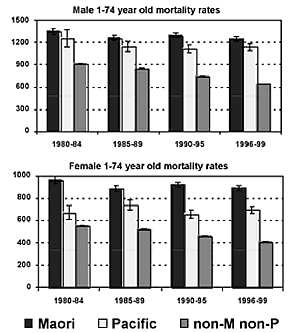
It is worth making a short but important point here: The higher up the graph you are the shorter your life span. Maori males do not on average live long enough to collect their superannuation and the trend is worsening in contrast to non-Maori where long life is increasing
CV Mortality & Revascularisation
Mortality vs Intervention, Males (Rates per 100,000)
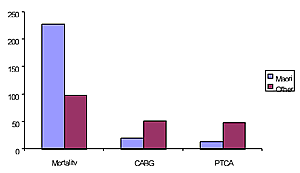
It is worth making a second short but equally important point here also: Maori have twice as much heart failure and receive less than half as many life saving interventions (bypasses and angioplasty) than all other New Zealanders on average
I picked these two points because the first illustrates the incontrovertible macro level evidence. The second shows at a personal level the dilemma many Maori find themselves with in the health system that should give them access to services to keep them well and it doesn't.
Which of the above statements does not meet any reasonable person's view about a level of need? So why is the PHO policy developed to explicitly address this need under the Brash hammer as being race based and not need based?
The PHO allows for population based funding. In short, when you go to see your doctor she gets paid not by the number of times you turn up (which used to be the case) but by having you enrolled on her patient register. Why is this? Because the government wanted to make it cheaper for you, the patient, to visit the doctor. So instead of you paying more each time you visited the government paid the doctor more to be available to see you when required without you bearing the cost.
This change means the government is now paying for GPs to look after a community (or population) of patients, not just individuals. It also wanted to make sure that those with the highest need got access to this increased benefit as fast as possible. So in the first instance this funding went to the Gps who looked after the old, the young, the chronically ill and those most evidentially disadvantaged in health status (Maori and Pacific).
The government also said it would apply similar levels of funding to all New Zealanders over a 5-8 year period. Given that this is the biggest leap in investment in primary care funding for 50 years this was not an unreasonable plan. Deal with the highest need immediately and phase in benefits to all.
Dr Brash attacks this however because one of the PHO criteria. This criterion gives higher funding priority to a PHO if they have greater than 50% of their population who described themselves as being of Maori of Pacific Island origin, or are within the highest 20% of deprived population in this country. In short, based on evidence of need, your PHO gets more money. Dr Brash chooses to view this through a contrary lens. In spite of the overwhelming evidence in support of need, he claims this is racial preference.
This is where I think his analysis is dead wrong. In applying a population-based focus to primary health care the government has understood something fundamental about Maori society that has eluded Dr Brash. If it is to reverse the life expectancy trends of Maori then perhaps the benefits of care might often be best delivered within a collective framework or ethic that is far more intuitive to Maori than to Pakeha. This is actually at the heart of the matter of efficiency. It means more Maori health providers. If we are to support Maori to help themselves, we need to support options to deliver their own care in ways most intuitive to their own social system. Plain, rational, economic common sense.
That's is not needs-based, says Dr Brash, that is race-based. I invite you to make up your own mind.
Another key point about this money discussion is the difference between equality and equity of access. Dr Brash says we all should be treated the same. If that were the case we would not have a pension system. We are clearing discriminating in favour of the aged when they get benefits the rest of us don't receive. We are also treating families differently to single people. Families get tax rebates for children, single childless people don't. Is Dr Brash saying he will stop this?
Treating every one equally therefore is not nearly as simple as it sounds. A better indicator is equality of access. On that basis we pay the pension to the elderly because we acknowledge their right to participate economically in the fruits of society even though they no longer work. We also support the unemployed for similar reasons, even though with a degree more scrutiny. We also offer loans to students. This is all about evening-out an uneven playing field and for the most part gains wide public support.
So how do we guarantee equality of access for Maori for life saving heart interventions? Do we do something more for Maori than non-Maori to improve that access? Of course we do on the same basis we pay pensions. We do so because we intuitively believe Maori have the right to the level of life-expectancy that non-Maori experience.
It's not that complicated I would have thought. Why has Dr Brash failed to grasp it?
Countering Maori influence
This is the one law for all argument where in a democracy majority rules. More particularly, this is also about who is entitled to hold sway. Who exercises influence so university places are available in law and medicine? Who can hold up courts and tribunals and on what basis and who is missing out when influence is being exercised that is contrary to their interests?
Dr Brash is addressing his message directly to those who feel that the minority are keeping them at a distance from the centre of power. When a majority feels a threat to its standing, the reaffirmation in powerful terms of the maxim one person one vote under one law, provides them with a great way on getting tickets back into the front seats.
This is the also the home of the 'tikanga' argument. The fact that the hospital staff are being required to learn tikanga best practice for dealing with their Maori patients is a call to arms. If this is the case why aren't they learning Somali best practice and Indian best practice?
So why don't we examine this?
What is tikanga? Tikanga is about exercising your cultural manners in order that relationships are protected. It is practised every where every day by all of us but when you are part of the majority (dominant) culture you hardly notice because it is intuitive to your world view. That is until someone offends against your sense of proprietary. Helen Clark offended Dr Brash's Pakeha tikanga when she refused to allow grace and wore trousers at the function for the Queen. This was not a religious objection from Dr Brash. Rather he was offended that appropriate Pakeha protocol of formal dress and the formal introduction of the meal was not followed thus risking a potential slight to the Sovereign. Importantly, the focus of his concern was the welfare and dignity of the guest, not the providers of the hospitality.
Now Maori are clearly comfortable that the Pakeha tikanga exists for the most part. They are capable of following it without undue compromise to their worldview. But in some circumstances, they are clear that they must ensure that their own cultural manners take precedence. This occurs when they are in their own milieu, such as on the marae or when the dominant agenda (kaupapa) is Maori.
It also most definitely applies in matters of sickness, of physical, mental or spiritual vulnerability of any kind. The reason is simple. Without the protection that comes from tending to the wairua (sense of spiritual wellbeing within your kin group), the outcome for the patient whether they live or die is culturally compromised. Clearly a hospital is one such context in which an understanding of tikanga therefore makes huge cross-cultural sense. There is no treatment more patient-centred than ensuring the practice of sound tikanga.
It is therefore something of a tragedy that after 160 years of living with each other there are so few staff within the public hospital system that have confident and intuitive knowledge of such basic requirements of Maori. So now we have to institute a set of guidelines to help support and train them. It was not always thus. Early settlers and officials were relatively knowledgeable about things Maori. They had to be.
As to the Somali tikanga, you would be surprised as to the extent public health systems are responding by way of translators and support people and supportive reference materials for the new New Zealanders. If you give this any sort of thought you realise that this is all about understanding one another in order to be able to function in respectful harmony.
Not for Dr Brash however. He thinks that having to consider any tikanga apart from Paheha tikanga is according that group a special privilege. How strange?
Let's be clear. Countering Maori influence is also about money, more particularly about cost of compliance. Mono-culturalism is of its nature cheap and efficient. So when a taniwha holds up our building programme or a wahi tapu declaration stops us building a holiday house on the beachfront, then this offends not only our sense of 'oneness under the law' but also our maxim of economic efficiency.
Let's put aside for one moment the raft of legislation that legally provides for more than one view on resource consent matters and deal with the substance of the concern that Maori are getting special treatment, such as with the tikanga illustration above.
What exists here is the playing out of 'dual views' of our country and our world. For the most part these worlds coincide. But as the recent foreshore debate shows there are times when the difference can be stark. When this happens Maori are attacked for holding things up, for not seeing things the way we see them or for being unreasonable.
An example is the 'taniwha' example. For Maori the announcement of the appearance of the taniwha activates a specific cultural metaphor that signals that a protection of a relationship is being breached, or is about to be breached. It often involves the prospect of danger or death. It is a serious matter and serious attention needs to be paid to consequences. Right relationships need restoring.
Thus when a stretch of roadway had seen repeated deaths from car accidents tangata whenua were clear that the matter needed sorting. Except that such sorting required discussion and perhaps a ritual response which in itself required a delay to the project, or even a redrawing of the road. The matter quickly became a contest between science and superstition with a hint of commercial gain thrown in for good measure. What should present as a constructive and appropriate contribution to the solving of the problem, death on this road, becomes belittled as a cultural match-up between the space-age and the stone-age.
But is it not true that Pakeha take meaning from cultural metaphors as well? Let's stay with the roadway example. Who of us has not seen the line up of white crosses on the roadside of SH1 bedecked with flowers, occasionally inscribed with names of those killed at this spot? What are these if not cultural metaphors? They at one level mark the simple passing of the deceased. At another level they sound a warning: be careful how you drive here. At yet another level the use of the Christian cross calls down the protection and forgiveness of a God that looks over us. Even an agnostic can get a grip of this regardless that they give it no credence.
Now tell me there would be no reaction in the Pakeha community if one night Transit decided to run down this highway and remove all these crosses without explanation but because they are inconvenient or unsightly. There would be huge public outcry. Why? Because people recognise these symbols are about deep meaning in their lives - don't trifle with them.
So what is it therefore that stops us from recognising that Maori might have a different meaning system (or worldview) to Pakeha and thus take the trouble to learn the skills of negotiating these dual views with each other?
My answer here might surprise you. I suggest what stops us is a massive Pakeha disadvantage in these discussions.
For most Maori in NZ who are representing a Maori view of an issue, they will be totally conversant with the Pakeha view of that same issue. The reason is simple. Their exposure to things Pakeha since 1860 has been comprehensive and without escape. Contrast the average Pakeha person of our acquaintance. They can live a full life in NZ and have never encountered Maori in their own milieu be it at hui, tangi or on the marae. Therefore when it comes to negotiating Treaty related matters such as resource consents where different views of an issue are legitimated by statute, they are often at sea and forced to seek and pay for Maori advice to make meaningful discussion possible.
This is why the 'countering Maori influence' appeal of Dr Brash has caught hold. Quite simply, he is saying to worried Pakeha: we know you are uncomfortable with this need to consider another worldview; we know how it makes you feel vulnerable. Don't worry, under us we will make it all go away. But will it?
Competing cultural histories
This is about who do we believe, not just about what we believe. An explosion of historical literature has in the space of one generation turned many of our cultural myths on their head. Further, the detailed historical record in the Waitangi Tribunal, a bi-partisan tribunal, shows a different picture to the education received by those of us born between 1940 and 1960. This is not universally popular.
For many of us there is a large knowledge gap. Most New Zealanders do not have a detailed understanding of the competing views of our cultural history. Therefore when Dr Brash says enough is enough he is speaking to an audience prepared to be engaged with a vague idea of historical injustice but clear that it holds no contemporary relevance.
In many respects Dr Brash has given up on the veracity of the historical argument because to him it has only one strategic relevance and that is to settle and close off remaining claims. In short he will settle for a view of history that shows colonisation severely disadvantaged Maori in some places, that they were economically and culturally impoverished by its effects and that the Tribunal should get on and make its deliberations and the Crown should settle.
All this rather leaves many of us aged 40 and older who are currently the 'influence' generation somewhat bewildered and bearing the brunt of the historical revision. This is too tough for some. Many are saying enough already! Brash has heard them.
As he said at Orewa, "Many things happened to the Maori people that should not have happened. There were injustices and the Treaty process is an attempt to acknowledge that and to make a gesture of recompense. But it is only that. It can be no more that that."
This is not good news for those Maori who have settled Treaty claims on the basis that their manawhenua (their tribal authority within a region) has been affirmed. Explicit in those settlements has been the agreement that they will have a part in the shaping of the future of Aotearoa where the Treaty has a contemporary role to play. Negating this is dire news indeed. Yet another agreement with the Crown is about to be threatened because one of the contractual parties no longer subscribes and does not consider themselves bound by their predecessors.
This is very important. The Treaty settlement policy is quite explicit that the recompense offered is woefully inadequate as reparation, but that the future partnership relationships will help to assuage the uncompensated losses of the past. If Maori are to lose that ongoing future relationship with the Crown under a Brash government, then the whole basis of the settlements policy will have been undermined. This is a sure recipe for another round of grievance thinking, instead of a positive future.
Looking to the Treaty as a template for the Future - widening the debate
The central problem with Dr Brash is more substantive than even Maori apprehension about yet another welching on the Treaty undertakings by the Crown. It is simply that as a proposition or a vision for the way our future nation might look it lacks confidence and breadth. The scope is shrunken, catering to a fearful audience seeking solace against a rising and increasingly sophisticated view of what democracy in a Treaty based, multi-cultural society may look like.
I want to propose to you the how the foundations of such a society might be described and show you by way of illustration, where they actually exist as we speak now.
Let me begin by addressing the mana of the signatories to the Treaty, Mana Pakeha and Mana Maori. Why the focus on mana and what is this all about?
My reading of mana in this context can best be explained by the English words of honour, integrity and respect in a manner that is intuitive to relationships and assumes permanence. These are the admirable qualities of the human race at its best and in Aotearoa New Zealand these qualities abound. Perhaps in this current debate however they are a little hidden and have been lost sight of.
So let us remind this current generation of what has been achieved in an assessment of our history. What has ennobled this debate in the last 30 years? Let me pick five examples.
Most definitely the establishment of the Waitangi Tribunal. This tribunal conceived by Matiu Rata but delivered by a Labour Government began in 1975 with a limited mandate to look at contemporary grievances. In 1985 under David Lange it increased its mandate back to 1840 and the Treaty signing. It has had bi-partisan parliamentary support up to now.
This decision has proved decisive in race relations in this country. It has provided the forum, some would say 'release valve', for Maori who want their history recognised, their experience recorded, some compensation attempted but most acutely, their mana restored. Maori are hugely realistic that there is no going back to 1840. But they are also canny enough to know that affirmation of their manawhenua (tribal authority over a region) within their rohe (region) gives them opportunities for participation in cultural and commercial affairs previous denied them.
This restoration of mana, most notably by the defining of manawhenua is extraordinarily important to tangata whenua and barely understood by a handful of Pakeha. Concluded settlements that define uncontested manawhenua gives the holders significant advantages in recognition by local authorities, government institutions, the Courts and other Maori.
The prospect that manawhenua could be relegated once again to a matter of no importance in the wider society is truly mind-boggling. Especially given that the whole Treaty process turns on the understanding of being able to identify who indeed the Crown relates to in matters of governance around its Treaty responsibilities.
The writing of our history in new ways. In this period of immense creativity we have see the emergence of major scholarship from Claudia Orange, Ann Salmond, Jamie Bellich, Judith Binney, Alan Ward and Michael King, all Pakeha. They have taken a sober and hard-headed view of the historical record that first emanated from the pens of Peter Buck and Keith Sinclair. There are many others, both Maori and Pakeha who have shaped the new written record through the histories commissioned by the Tribunal.
The approach of the Courts. Required to articulate what an application of Treaty principles might look like they have set in place working principles that successive governments have been able to shape to their political colour - that is up to now.
The emergence of Maori school choice. There are now full immersion Maori educational options from pre-school to tertiary education. None of these existed 30 years ago.
The renaissance in Maori arts and performance. Undoubtedly the Te Maori exhibition was the most significant cultural export expressing our essential New Zealand self-confidence the rest of the world had experienced in this period. It has been followed by an unprecedented take-up by Maori in the arts producing for this country some of its most significant branding for overseas markets.
The purpose of these illustrative examples is to demonstrate that Aotearoa is a different place with different cultural reflexes to 30 years ago. Further this mix exemplifies an emerging cultural confidence for all New Zealanders in our nation.
So let us now return to the importance of mana. For Treaty settlements to stick they require mana to be at stake. Both parties have to have a lot to lose if the threads become undone. This means that future relationships need to be conducted with some care in the knowledge that reconciliation and closure have come at a price. And that price is compromise.
Maori have in fact agreed by settlement that a contemporary restoration to their position in 1840 is unsustainable, even though the gravity of their exclusion from the economic and cultural fruits since 1840 is conceded by the Crown.
Often the most important value of the settlements is not in fact the money. As useful as it may be for iwi redevelopment it will quickly pass from memory. It is as I said for Maori the restoration of manawhenua which carries with it clear expectations of participation as equals in the shape of the future of this country, not as just one of many but as a duly constituted founding participant of this society. This participation is as a full player, no longer the supplicant at the Crown's table. The Treaty process, so often derided by its critics as self-serving and encouraging of a victim mentality within Maori, has actually achieved precisely the opposite effect for the successful claimants.
The mana at stake on the Crown side is precisely that deriving from the recognition by Maori that the Crown could have said 'no'. After all it had for over a 130 years. But the Crown (the people of New Zealand) did not say no. They said instead, 'let's hear what you have to say and let's clean up outstanding matters between us.'
This is a breathtaking position to be taken by a dominant culture anywhere, and it is possibly unprecedented in our living memories. People have talked in comparative terms of the significance of the Truth and Reconciliation Commission in South Africa. This came after the ending of apartheid when the power dynamics had reversed in favour of the black population. We need only look to Australia where 'not saying sorry' has reached such absurdly gothic proportions to see how far New Zealand has come.
And let it be said clearly. The Waitangi Tribunal would not have functioned without the consent of the population, the majority of whom are Pakeha and other recent or long established migrants. In short, much honour integrity and respect has been put on the line in making progress. These are not matters with which to trifle no matter the short-term gain.
That is why the shrunken view of our national capacity to aim for the good that Dr Brash is promoting needs to be challenged for the smallness of vision that it represents.
If we therefore make the reasonable assumption that all Treaty settlements will be settled in the lifetime of our children what shape will New Zealand be in and what will be that relationship between Maori and the Crown into the future? Will it be as Dr Brash suggests, a non-question because there will no longer be Crown and tangata whenua as the Treaty will have been put to bed and NZ will be far too diversified?
I suggest not.
I want to finish this paper with an illustration by way of a case study. I refer to Ngati Whatua o Orakei, the hapu of Ngati Whatua iwi who by a 1991 Act of Parliament are recognised as holding manawhenua standing in the Auckland isthmus.
The re-emergence of this tribal hapu after nearly a 110 years of seeming absence from public affairs is one of the startling re-discoveries of Auckland in this last 30 years and it shows us with precise clarity to what heights the future of this nation could genuinely aspire.
So let me take you through a brief journey traversing three centuries:
In 1840, just months after the signing of the Treaty, Apihai Te Kawau, paramount chief of Ngati Whatua invited Governor Hobson to come to Tamaki Makaurau to set up his seat of government. He offered Hobson an inducement. Come, he said and I will give you 3000 acres to develop your settlement. Make this the capital and I will give you more. The area transferred in modern day terms was Parnell, the CBD, Ponsonby, Grey Lynn, Herne Bay and some of Newmarket and Mount Eden
In 1841 a gathering of 1000 Ngati Whatua greeted Hobson on the shores of Okahu Bay. Te Kawau addressed him. "Governor, Governor, welcome as a father to me: there is land for you ... go and pick the best part of the land and place your people, at least our people upon it."
The block chosen is latter day Westmere, Pt Chevalier, Western Springs, Waterview, Avondale, Mount Albert, Titirangi, Sandringham, Mt Roskill, Three Kings, Balmoral, Kingsland, Mount Eden and Epsom.
This represented the transfer of a further 8000 acres.
Why would Apihai have made such a significant gesture? What was behind his thinking? The answer was an alliance. The transfer of land was in Maori terms a "tuku rangatira", a gift with strings attached. Those strings were the advantages to be gained from commerce, education and health and the protection of all under the law. The Orakei report of the Waitangi Tribunal commented that the " settlers came not as conquerors, not as interlopers, but as Te Kawau's invitees to share the land with Ngati Whatua."
All this contains a certain poignant relevance for in 1869 at a hearing of the Native Land Court Apihai Te Kawau was asked "Who were the people who sold Auckland to the Europeans?" The answer was "I did not sell it, I gave it to them." On the further question of "Did not the government give you and your people money for it afterwards?" Apihai answered: "No, I have been constantly looking for payment but have not got it."
Why was Apihai in the Native Land Court? Because within 5 years of the invitation to Hobson to come to Auckland, Ngati Whatua who had previously uncontested standing as manawhenua across the Auckland isthmus had seen over 100,000 acres of its whenua disappear with little to show for it. By 1868 they were reduced to the 700 acre Orakei Block deemed by the court at that time to be forever inalienable, not to be sold. This was later reversed just before the first world war. In 1913 government changed the policy. While Ngati Whatua leaders were with New Zealand troops overseas the government passed a law allowing for the individualisation of title. The land was sold off and what remained then was a marae, a pa and an urupa based at Okahu Bay.
In 1951 the marae and pa were deemed an eyesore on Tamaki Drive and unsafe for habitation. The Auckland City Council evicted all residents to new State housing on the Kupe St hill and razed the marae and attendant buildings to the ground. The quarter acre urupa was all that remained.
Thus to summarise: the once proud people of the Tamaki isthmus, at 1840 holding sway over the whole of Auckland; the people who invited and induced Hobson to Auckland to form the seat of government; were reduced in precisely 112 years to a landless few living off the state. They were without a marae to whakapapa to and were left with a quarter acre cemetery being the last piece of land they could tribally claim as its own.
It is not surprising therefore that in 1978 when a group of Ngati Whatua said 'no!' to the Muldoon government's plan to subdivide what they genuinely believed was their legitimate estate, people everywhere began asking, "Just who are these people?"
Bastion Point became the fire lighter for the first substantial Treaty examination, first by Aucklanders and then by the rest of the nation. By the time the occupiers were evicted 506 days later by the greatest show of police force used against New Zealanders in the 20th Century, most people knew that the Treaty was going to play a part in our lives, even if they were not sure how.
In his second claim before the Waitangi Tribunal (Wai 9) Joe Hawke and others outlined the case related to the disposal of the Orakei Block, the land deemed in the mid-19th century to have been inalienable. The outcome was unequivocally in their favour and Bastion Point in 1991 was finally transferred back into Ngati Whatua's hand by Act of Parliament. This was the one of first successful appeals to the Tribunal of any Maori iwi in the country and was the precursor for the many claims currently filed.
Let's for a moment pause to consider the first thing Ngati Whatua did when it took back the land.
The first thing it did was to give a huge chunk of Bastion Point back to Aucklanders. That's right, they gave it back to you and me for our unimpeded use. The land I am talking about is the whenua rangatira land. The land with the best views in all of Auckland. The land where Michael Joseph Savage rests. Ngati Whatua agreed to jointly manage this with the Auckland City Council (the same Council that had ordered the burning of their marae) for the benefit of all the people of Tamaki Makaurau.
When I therefore reflect on the mana of Ngati Whatua, I remained truly humbled. That a people who sought for 150 years to get some form of justice that recognised their cultural destitution, could in their moment of triumph, react with such generosity to those who dispossessed them is an act of munificent genius.
How for a moment can we as New Zealanders, in receipt of such insight into human affairs, begin preparation for marginalising them, our Treaty partners, once again?
How can we with the consciousness we have now of our history, be saying to future generations of our citizens, it is no longer your affair? We are done with that.
This is where the true heart of this debate lies. Not in the tawdry accounting of who gets what when, or whose version of the world must triumph.
When I talked earlier of the breathtaking decision of Pakeha, as the dominant group, to look again at our history and redress the wrongs where possible I spoke of mana: those characteristics of integrity, honour and respect. I celebrate these Pakeha attributes in my generation and my parent's generation. They in good faith took the risk to lift off the lid and look once again at our history, allowing all voices to be heard for the first time.
They did this not because they understood in its entirety where it might lead, but because there was an emerging consensus that this was the right thing to do. Their example points us to the wider picture, to pursue the greater good in our dealings with each other.
Today, this largely silent consensus is under threat. Some of the implications of this newly discovered history are hard to swallow. Their articulation has on the surface at least, unsettled the Pakeha centre of cultural gravity, reduced our confidence in our cross-cultural future. We are suddenly nervous about what we might lose, forgetting for the moment the enormous lift to our Pakeha mana secured by our actions as a just and open people.
My challenge to my fellow Pakeha is to return to your original instincts. This is a debate about pride in our achievements and self-belief. It about the soul of our nation that either recognises the seeds of its own genius and the consummate ability within ourselves to articulate and solve our own problems, or loses its nerve and resorts to a one size fits all solution.
So slick, so simple, so seductive. So wrong. Let's not let it happen.
This weblog posting is based on a public talk by Pat Snedden at St Benedict's, Newton, Auckland on Sunday 29 February 2004